
Nationwide Roofing Southern provides reliable roofing services across Bognor Regis. With over 50 years of experience, we offer tailored roofing solutions with free surveys and quotes.
Or speak with our friendly team:
Bognor Regis records some of the highest sunshine totals anywhere in Britain, and that is harder on a roof than it sounds. Sunlight is one of the mechanisms that wears a roof out. Ultraviolet breaks down the binders in felt and the surface of plastics and rubbers, and the daily heating and cooling that comes with it makes every material expand and contract, over and over, at every joint. On this stretch of coast a roof gets salt and wind like anywhere else on the Channel, and a good deal more sun on top.
Or speak with our friendly team:

We prioritise timely project completion with minimal disruption to your home or business, ensuring you receive dependable roofing solutions when you need them.
Our fully accredited and qualified team adheres to the highest industry standards, ensuring safe, professional roofing installations and repairs.
We use premium materials to create long-lasting, weather-resistant roofs that protect your property for years.

We keep every system in house rather than fitting the one we happen to specialise in, so the advice is about your roof and not about our kit:
Or speak with our friendly team:
A new roof starts underneath the covering. We strip back, check the battens, underlay and rafters, and put right whatever the old roof was hiding before anything new goes on. On a fully exposed Bognor Regis roof the specification is chosen with sun as well as salt in mind, because the two wear out different things. Everything is laid to the manufacturer’s specification so the warranty stands behind it.
Roofs get replaced when the covering has aged out rather than after one failure. Here that shows as felt gone brittle and crazed, plastics that have chalked and lost their colour, and mortar and fixings worked loose by years of expanding and contracting every single day. A re-roof is also the moment to deal with insulation and ventilation, which matter more on a low building where a large roof sits directly over the living space.
We trace a leak to where the water is getting in rather than to where it appears on the ceiling. On this coast the recurring causes are split seams and cracked upstands on flat roofs, where thermal movement has worked at the same joint for years, alongside the wind and salt damage you would expect anywhere on the Channel. Small repairs done early cost far less than what follows.
Flat roofs are everywhere here, on extensions, garages, porches, dormers and low rise blocks, and they take the full weight of the sun all day. We install and repair felt, single ply, EPDM and GRP fibreglass systems, set the falls so water reaches the outlets rather than standing, and detail the upstands and seams properly. On an exposed sunny roof the joints are where it matters, because that is where thermal movement concentrates.
Clay tile and slate on the older seaside property, concrete interlocking across the later estates. We match size, profile and colour as closely as we can source when new material is needed, and weathered material never matches new exactly, which is more visible here than most places because strong light shows every difference in shade. Fixings are specified for the exposure rather than the minimum.
A green roof needs a deck that will carry the loading, the right falls, and a waterproofing layer designed to sit beneath a growing medium. One genuine advantage in a sunny spot is that the planting shields the waterproofing from direct sunlight, so the membrane underneath is not being cooked. Around Bognor the practical candidates are usually flat areas on extensions, garages and outbuildings. We survey before specifying anything.
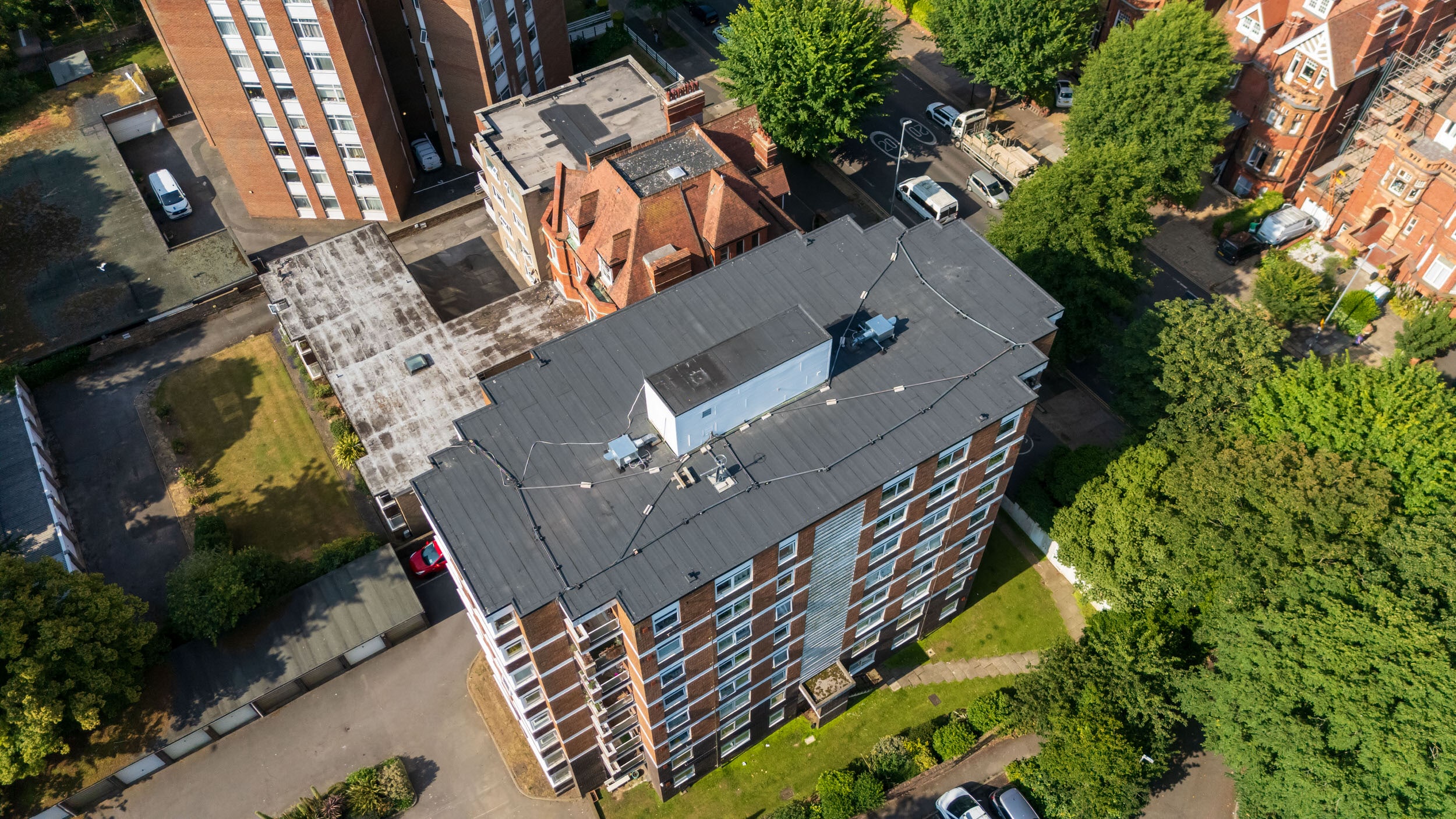
Hot melt is a monolithic waterproofing system, laid hot so that it bonds completely to the deck with no seams or laps to fail. It earns its place where a leak would be expensive and disruptive to trace, and where the waterproofing sits beneath something else: a podium deck, a roof terrace, a car park or the build up of a green roof. Because the membrane bonds fully to the substrate, water cannot track between layers, so a defect stays where it happened rather than surfacing somewhere else entirely.
Having no seams matters here for a second reason: seams are where thermal movement does its work, and a bonded membrane sitting under a protective layer is not exposed to direct sun at all. Around Bognor Regis it suits larger flat areas and any roof carrying something above the waterproofing.
Or speak with our friendly team:
Bognor and the villages around it sit on the flat coastal plain, and the building stock reflects a seaside town that grew quickly: Victorian and Edwardian terraces and villas near the front, then a great deal of inter war and post war single storey and low rise housing through Felpham, Aldwick and Bersted, and modern estates beyond. That means an unusually high proportion of roof area per building, and a great many flat roofs on extensions and garages, all of it fully exposed to the sky.
Or speak with our friendly team:


Nationwide Roofing Southern has been roofing across the South East for over 50 years. We are members of the National Federation of Roofing Contractors and we are CHAS accredited, with full public liability and employer’s liability insurance in place on every job and a certificate available on request. Our system warranties cover labour, materials and damage. Surveys and quotes are free, come in writing, and carry no obligation.
Or speak with our friendly team:
If a Bognor Regis roof is leaking, has a flat covering that has gone brittle or crazed, or is simply old enough to be worth a proper look, the survey costs nothing. We look at the roof and the loft rather than judging it from the pavement, and put in writing what we found, what we would do and what it includes.
Or speak with our friendly team:
Bognor Regis sits on the south-facing West Sussex coast, with one of the longest stretches of unbroken Channel exposure on the Sussex shore. Salt-laden air corrodes metal flashing, fixings and untreated lead faster than further inland, and south-westerly autumn gales come straight in off the open sea, testing ridge tiles, slate clips and chimney pointing hard. Long humid spells in summer drive moss and algae growth on shaded north-facing slopes. We specify marine-grade fixings and account for the corrosive coastal environment on every Bognor Regis job.
Yes. Bognor Regis has conservation areas covering parts of the seafront, the Steyne and several historic streets, with listed buildings including the Royal Norfolk Hotel and the pier-area heritage buildings. Conservation area rules and listed building consent are the homeowner’s responsibility and can restrict roof shape, slope, tile material and rooflight placement. We recommend checking with Arun District Council’s planning team before any roof work begins, and we will work to whatever specification the council approves.
Bognor Regis has a strong stock of Edwardian and inter-war seafront terraces and detached villas with natural-slate or clay-tile pitched roofs. Post-war housing across the town typically uses clay tile or concrete interlocking tiles. Seafront apartment blocks and modern estates use a mix of pitched concrete tile and hot melt or EPDM flat systems, often with marine-grade fixings. Bungalows are common across the town and need careful flashing checks at parapet abutments. Each comes with a different maintenance pattern.
After a strong southerly or south-westerly off the Channel, look for slipped, cracked or missing slates and tiles, dislodged ridge or hip tiles, debris in valley gutters and parapet boxes, and damp patches on top-floor ceilings or chimney breasts. Salt-corroded fixings on older lead flashing are a particular vulnerability on Bognor Regis seafront properties. If you spot anything, get it covered or assessed before the next weather front arrives.
Yes, and on this coast it is one of the main things wearing a roof out. Ultraviolet breaks down the binders that hold bituminous materials together and attacks the surface of plastics and rubbers, which is why old felt goes brittle and crazed and why plastic components chalk and lose their colour. Tile and slate are largely indifferent to it. Anything organic or synthetic is not. Bognor gets more of it than almost anywhere in the country, so materials here reach that point sooner than the same materials inland.
Because they are pointed straight at it. A pitched roof takes the sun at an angle for part of the day; a flat roof takes it square on from morning to evening, and the covering has nowhere to hide. On top of the ultraviolet, a dark flat roof gets genuinely hot in summer and cools right down overnight, so it expands and contracts every day of its life. Do that for years and the joints, seams and upstands are where it tells, which is why flat roofs here nearly always fail at a detail rather than in the open field.
Noticeably, and they fail in opposite ways. The south facing slope gets the ultraviolet and the heat, so anything organic on it ages faster and the mortar and fixings take more thermal cycling. The north facing slope stays damp and shaded, so that is where moss and algae take hold and where frost lingers. It is quite normal for one side of a roof to look considerably older than the other, and for a repair on one side to be the wrong answer for the other.
Everything on a roof expands when it warms and contracts when it cools, and different materials do it by different amounts. That is fine while everything can move a little. It becomes a problem where two materials are fixed rigidly together, or where a joint has no room to take up the movement, because then something has to give and it is usually the weaker of the two. It is a slow, cumulative process, which is why a detail can perform for years and then start opening up in a single hot summer.
To how hot it gets, yes. A dark surface absorbs more and runs considerably warmer in summer than a pale one, so it expands more and cycles harder. That does not make dark roofs a mistake, and on a pitched roof it rarely decides anything, since the covering choice is usually governed by the building and by what is permitted. It matters most on a flat roof, where the surface is exposed all day and where the finish is genuinely a specification decision rather than an aesthetic one.
It can, and it is worth raising before the covering is chosen rather than afterwards. Some systems carry a protective surface as standard, others rely on a finish applied over the top, and anything that shades the membrane, whether that is a ballast layer, a walk on surface or the build up of a green roof, takes the ultraviolet off it entirely. Which of those makes sense depends on the deck, the falls and what the roof is for. We survey and set out the options rather than fitting the same thing everywhere.
Or speak with our friendly team:
Or speak with our friendly team:
At Nationwide Roofing Southern, we are members of the National Federation of Roofing Contractors (NFRC) and we are CHAS accredited. Our accreditations reflect our commitment to high-quality service, strict safety standards, and lasting results. Whether it’s repairs, installations, or maintenance, you can trust our skilled team to deliver reliable roofing solutions that meet industry expectations.

Cookies on this site
Essential cookies keep this site working. Everything else is optional and stays switched off until you choose.
Privacy settings
Choose which optional cookies this site may use. Each purpose below says what it does and which companies it involves.