
Nationwide Roofing Southern provides trusted, high-quality roofing services across Crawley. With over 50 years of experience, we deliver tailored roofing solutions with free surveys and quotes.
Or speak with our friendly team:
Crawley was built out as a New Town, neighbourhood by neighbourhood, which is why so many roofs here were laid at the same time, in the same materials, with the same detailing across hundreds of properties at once. Roofs laid within a few years of each other reach the end of their working life within a few years of each other, which is why one road can see several re-roofs in a short spell while the next is untouched. It also means a neighbour’s roof is often a fair guide to your own.
Or speak with our friendly team:

We prioritise timely project completion with minimal disruption to your home or business, ensuring you receive dependable roofing solutions when you need them.
Our fully accredited and qualified team adheres to the highest industry standards, ensuring safe, professional roofing installations and repairs.
We use premium materials to create long-lasting, weather-resistant roofs that protect your property for years.

Nationwide Roofing Southern has been roofing across the South East for over 50 years. We are members of the National Federation of Roofing Contractors and we are CHAS accredited, and full public liability and employer’s liability insurance is in place on every job, with a certificate available on request. Our system warranties cover labour, materials and damage. Surveys and quotes are free and come in writing, and if a roof does not need the work we would sooner say so.
Or speak with our friendly team:
A new roof starts underneath the covering. We strip back, check the battens, underlay and rafters, and put right whatever the old roof was hiding before anything new goes on. On Crawley estate housing that often means finding that the original felt has perished across the whole slope rather than in one place. Everything is laid to the manufacturer’s specification so the warranty stands behind it.
Concrete interlocking tiles are hard wearing but they do not last indefinitely. They go porous and rough, absorb water instead of shedding it, and the fixings fatigue until tiles start to slip. On estate housing that shows across a whole slope rather than in one spot, which is the sign that a re-roof rather than a repair is the honest answer. Where neighbours are at the same stage, doing a run together is usually cheaper and less disruptive than one at a time.
We trace a leak to where the water is actually getting in rather than to where it shows on the ceiling. In Crawley that is often a blocked valley behind leaf fall, a slipped tile on a shaded slope, or mortar gone from a ridge line that has not been touched since the house was built. Small repairs done properly and early cost far less than the ceiling that follows if they are left through a winter.
Flat and shallow pitched roofs are everywhere in Crawley, on maisonette blocks, garage runs, porches and rear extensions. We install and repair felt, single ply and liquid systems, set the falls so water reaches the outlets instead of sitting, and detail the upstands and abutments properly. Shallow roofs are less forgiving than a steep pitch, so we check the existing build up rather than simply overlaying what is already there.
Concrete interlocking tile across the estates, clay tile and slate on the older town centre property and the surrounding villages. We salvage and re-lay sound material where we can, and match size, profile and colour as closely as we can source when new is needed. Weathered material never matches new exactly, and on a run of identical estate houses that is worth knowing before the work starts rather than after.
A green roof needs a deck that will carry the loading, the right falls, and a waterproofing layer designed to sit beneath a growing medium. In Crawley the practical candidates are usually flat areas on extensions, garages and outbuildings, and newer commercial development where the weight was designed in from the start. We survey before specifying anything and will say plainly if a roof is not suited to one.
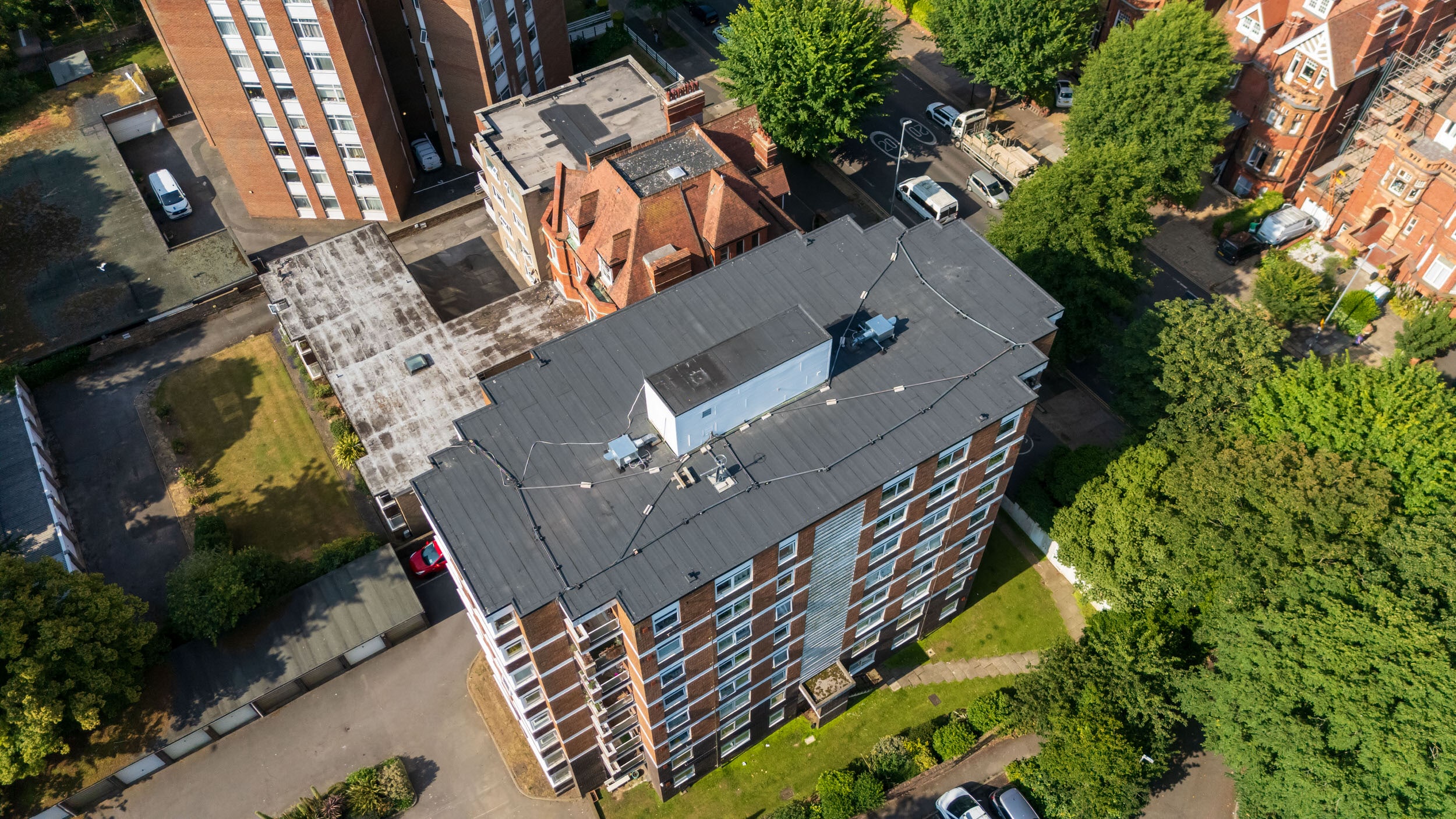
Hot melt is a monolithic waterproofing system, laid hot so that it bonds completely to the deck with no seams or laps to fail. It earns its place where a leak would be expensive and disruptive to trace, and where the waterproofing sits underneath something else: a podium deck, a roof terrace, a car park or the build up of a green roof. Because the membrane bonds fully to the substrate, water cannot track between layers, so a defect stays where it happened rather than surfacing somewhere else entirely.
In Crawley that suits commercial and industrial property with large flat areas, and residential blocks where getting back up for maintenance is difficult. It is one of our own core systems rather than something we subcontract, and we survey the deck and the existing build up before specifying it.
Or speak with our friendly team:
We keep every system in house rather than fitting the one we happen to specialise in, so the advice is about your roof and not about our kit. In Crawley that spans estate housing, maisonette blocks, the older town centre and commercial property:
Or speak with our friendly team:


Crawley sits inland with a great deal of mature tree cover around Tilgate, Worth and Ifield, and that changes what goes wrong here compared with the coast. Shaded north facing slopes stay damp long after the rest of a roof has dried, which suits moss, and leaf fall blocks valleys and outlets. Thickened moss holds water against the tiles and lifts them in a freeze. It is the displaced tiles and the water finding a way in that we get called to, rather than the moss itself.
Or speak with our friendly team:
If a Crawley roof is leaking, shedding tiles, or simply the same age as everything else on the street, the survey costs nothing and is the place to start. We look at the roof and the loft rather than judging it from the pavement, and put in writing whether it needs replacing, repairing or leaving alone, with a price against it.
Or speak with our friendly team:
Crawley sits in the West Sussex Weald just south of the M25, on largely clay soils. Roofs here face the typical Wealden mix: wet winters drive water through any weak point in flashing or pointing, and autumn leaf fall blocks gutters and valleys quickly in older residential areas. Wind exposure is moderate but post-war and modern estate housing with shallower roof pitches takes wind load differently from traditional pitched roofs. Frost damage to cracked pointing on older properties is the main winter risk. Salt-related corrosion is not a factor this far inland.
Yes. Crawley has multiple conservation areas, including the older parts of Three Bridges, Ifield, Worth and the historic town centre, with listed buildings throughout the older parishes. Conservation area rules and listed building consent are the homeowner’s responsibility and can restrict roof shape, slope, tile material and rooflight placement. We recommend checking with Crawley Borough Council’s planning team before any roof work begins, and we will work to whatever specification the council approves.
Crawley’s housing stock is dominated by post-war New Town development with shallow-pitched concrete interlocking tile roofs across the neighbourhoods. The older village cores at Ifield, Worth and Three Bridges retain timber-framed and tile-hung Wealden cottages with clay-tile or peg-tile roofs. Modern estate and apartment developments use a mix of concrete tile pitched and hot melt or EPDM flat systems. Each comes with a different maintenance pattern.
After a strong westerly or south-westerly blow, look for slipped, cracked or missing tiles, dislodged ridge or hip tiles, fallen branches across roof slopes, leaf-fall and debris blocking valleys and gutters, and damp patches on top-floor ceilings or chimney breasts. Slipped concrete interlocking tiles on shallow-pitched New Town roofs are a particularly common Crawley storm casualty. If you spot anything, get it covered or assessed before the next weather front arrives.
Crawley was built out as a New Town, so its neighbourhoods went up in concentrated programmes using the same materials and the same detailing across hundreds of properties. Roofs laid within a few years of each other tend to reach the end of their working life within a few years of each other too, which is why one street can see several re-roofs in a short period. If neighbours have recently had work done, the same issues are usually worth checking on your own roof.
Concrete interlocking tiles are hard wearing but they do not last indefinitely. They lose their surface over time, turning porous and rough so they absorb water rather than shed it. The signs are tiles looking pitted or faded, granules washing down into the guttering, moss taking hold more readily than it used to, and fixings fatiguing so tiles slip. On estate housing this tends to show generally across a whole slope rather than in one spot, which is what separates it from a single storm damaged tile. Replacement work carries a workmanship warranty from us plus the manufacturer’s warranty on the materials, both set out in writing with the quote.
Crawley sits inland with a good deal of mature tree cover around Tilgate, Worth and Ifield, and shaded north facing slopes stay damp long after the rest of a roof has dried. That suits moss. A light covering is cosmetic, but once it thickens it holds water against the tiles, washes down into valleys and blocks them, and in a freeze it can lift tiles as it expands. What matters is where that leads: displaced tiles and water finding a way in. If moss has been left long enough to move tiles or block a valley, the roof is worth having looked at properly rather than simply cleared.
Yes. A lot of Crawley’s estate housing was built with shallow pitches, and flat roofs are common on maisonette blocks, garage runs, porches and rear extensions across the town. We cover flat roofing and waterproofing on all of them, including hot melt systems. Shallow and flat roofs are less forgiving than a steep pitch because water sits rather than runs, so we check the falls, the outlets and the existing build up before recommending anything rather than overlaying whatever is already there.
We look at the roof itself and at what it is telling us from inside. That means the covering, the ridge and hip lines, valleys, flashings and any flat sections, plus the loft where it can be reached, because damp staining on rafters and felt often shows a problem before anything is visible outside. You get a written quote setting out what we found, what we would do and what is included. Surveys and quotes are free, and full public liability and employer’s liability insurance is in place on every job, with a certificate available on request.
Yes, alongside domestic work. Crawley has a great deal of commercial and industrial property with large flat roof areas, and that is where a system like hot melt earns its place, laid as a continuous waterproof layer with no seams to lift. The process is the same as for a house: we survey the roof and what sits beneath it, then set out in writing what we found, what we would do and what is included.
Or speak with our friendly team:
Or speak with our friendly team:
At Nationwide Roofing Southern, we are members of the National Federation of Roofing Contractors (NFRC) and we are CHAS accredited. Our accreditations reflect our commitment to high-quality service, strict safety standards, and lasting results. Whether it’s repairs, installations, or maintenance, you can trust our skilled team to deliver reliable roofing solutions that meet industry expectations.

Cookies on this site
Essential cookies keep this site working. Everything else is optional and stays switched off until you choose.
Privacy settings
Choose which optional cookies this site may use. Each purpose below says what it does and which companies it involves.