
Nationwide Roofing Southern delivers professional roofing services across Harrow. With over 50 years of experience, we provide high-quality roofing solutions backed by free surveys and quotes.
Or speak with our friendly team:
Roofing in Harrow covers a wider range of buildings than the borough’s reputation as a 1930s suburb suggests. On Harrow on the Hill itself there are older houses, tall and close together on steep ground, with slate and clay roofs that have been repaired many times over. Around Wealdstone, Kenton and the town centre the streets are Victorian and Edwardian terraces with party wall abutments and valley gutters. And across Pinner, North Harrow, Rayners Lane, Harrow Weald and Stanmore stands the housing the Metropolitan Railway brought with it: hipped clay tile roofs, half timbered gables, bay windows with their own small roofs, and a great deal of decorative tile hanging.
We repair, re-roof and build new roofs on all of it. That includes the loft dormers and rear extensions that have been added to so many Harrow houses since, the flat roofs over garages and porches, and the larger flat and pitched roofs on commercial buildings and blocks of flats around the town centre. Every job starts with a free survey and a written quote, so you know what we found and what we propose before anything is agreed.
Or speak with our friendly team:

We prioritise timely project completion with minimal disruption to your home or business, ensuring you receive dependable roofing solutions when you need them.
Our fully accredited and qualified team adheres to the highest industry standards, ensuring safe, professional roofing installations and repairs.
We use premium materials to create long-lasting, weather-resistant roofs that protect your property for years.

The typical Harrow house between the wars was built to look like a cottage, and the roof is where that shows most. Instead of large interlocking tiles it is covered in small plain clay tiles, laid double lapped so that every part of the slope has two or three thicknesses of tile over it. The same tiles then come down the walls: hung vertically on the gables, wrapped round the bays, sometimes covering the whole upper storey. It is a handsome finish and it is also a lot of roofing. A plain tiled roof with tile hung gables can carry several thousand individual tiles, each held by its own fixings and its own lap, and each capable of slipping, cracking or losing its surface to frost on its own.
That changes how faults show up. A broken plain tile rarely produces a dramatic leak because the tiles beneath it are still doing their job, so the damage builds quietly until a patch of the slope is past saving. Tile hanging fails at the edges, at the corners of bays and the heads of windows where the lead soakers were never quite right, rather than in the middle of a face. Reading a Harrow roof properly means knowing where to look, and it is why we survey these houses from close up rather than from the pavement.
Or speak with our friendly team:
New roofs in Harrow are most often on rear extensions, loft dormers and garage rebuilds attached to the interwar housing, where the new structure has to meet a plain tiled hipped roof cleanly. We design and install the whole system, structure, underlay, covering and leadwork, and we build the junction with the existing roof as carefully as the new roof itself, with insulation and ventilation included from the start.
When a Harrow roof has too many failing tiles to keep patching we strip it back, replace any timber that needs it, and lay a new roof with underlay, new battens and a covering that matches the house, whether that is plain clay tile on a Metroland semi or slate on an older property near the Hill. Ridges and hips go on as dry fixed systems so there is no mortar to crack, and any tile hanging is dealt with in the same job.
Slipped and frost damaged plain tiles, loose ridge and hip tiles, lifted lead at chimneys and party walls, and leaks at dormer junctions make up most of the repair work we do in Harrow, with the higher ground around the Hill, Harrow Weald and Stanmore producing the storm calls. We find the cause, not just the wet patch, and price the repair against what is actually needed.
Harrow has an unusual number of flat roofs on dormers, because so many lofts have been converted, and most of the older ones are on felt that has been patched. We install and replace flat roofs in EPDM, GRP, single ply and hot melt systems, matched to the size of the roof and what it drains onto, and we get the falls and outlets right so water leaves the roof instead of sitting on it.
Plain clay tiles and vertical tile hanging are the signature of Harrow’s housing and they need a roofer who works with them regularly. We replace individual tiles, re-fix and re-lead tile hung gables and bays at the corners and window heads where they fail, and repair or replace slate on the older houses, matching colour and profile so the work does not stand out from the street.
A flat extension or garage roof in Harrow can be turned into a green roof that shelters the waterproofing beneath it from sun and frost and gives the bedrooms above something better to look at. We install green roof systems over a properly specified waterproof layer, after checking the structure can take the weight of the growing medium when it is saturated.
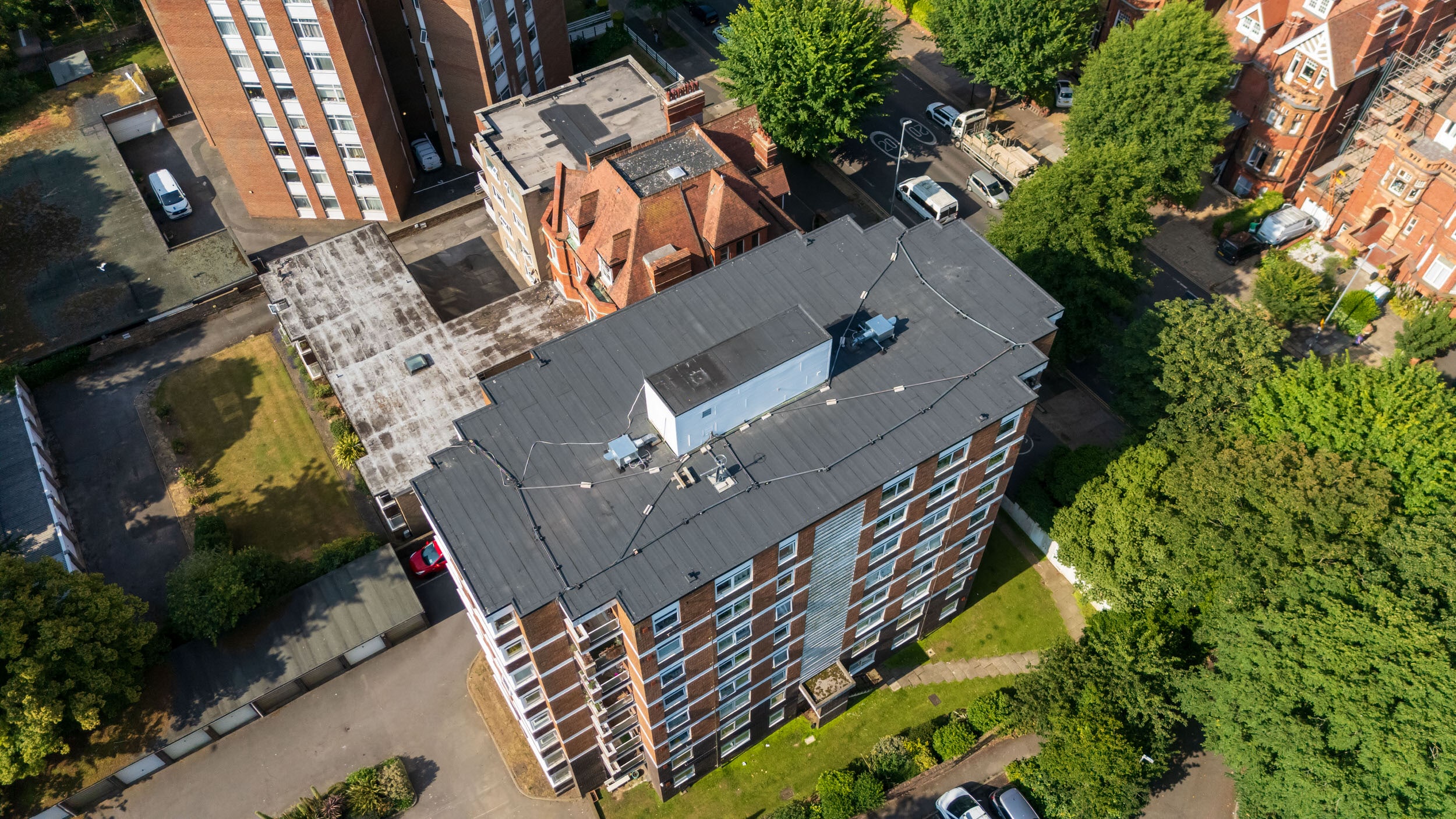
Hot melt is a seamless, liquid applied waterproofing with no laps or joints for water to find, reinforced as it sets. In Harrow we use it on the larger flat roofs over commercial buildings and blocks of flats, on podium decks, and on any roof that will be covered by a terrace or a green roof and cannot easily be inspected again.
Or speak with our friendly team:
Few boroughs have converted as many lofts as Harrow. A large hipped roof on a semi is an obvious place to put another bedroom, and over the years a great many have gained a flat roofed rear dormer, a hip converted to a gable, or both. Each of those adds a junction to a roof that was designed without one: a dormer cheek against the slope, a flat roof draining onto a pitched one, a new gable verge where a hip used to be. The junction is where the roof is now most likely to fail, and it usually fails some years after the conversion, once the original flashings and the felt on the dormer roof have aged at a different rate from the tiles around them.
We take those junctions seriously. When we repair a leak on a converted Harrow roof we look at the whole meeting point, not just the flashing that is visibly lifted, and when we re-roof a house with a dormer we redo the dormer’s flat roof and its abutments as part of the same job, so the new roof does not inherit the old weak spot.
Or speak with our friendly team:


Nationwide Roofing Southern has been roofing for over 50 years. We are members of the National Federation of Roofing Contractors and we are CHAS accredited. Every Harrow job is covered by full public liability and employer’s liability insurance, with certificates available on request, and our roofing systems carry a written warranty covering labour, materials and damage. On a house whose roof runs down the walls, a warranty that covers the whole system, tile hanging and leadwork included, is worth more than one that covers the slopes alone.
Or speak with our friendly team:
Whether the problem is a dropped tile on a Pinner gable, a dormer junction in Rayners Lane or an old slate roof on Harrow on the Hill, the survey is free and so is the written quote. Tell us where in Harrow the property is and what you have noticed, and we will arrange to come and look. Request your free Harrow roof survey.
Or speak with our friendly team:
More than people expect, though it is not the coastal kind. Harrow climbs from the flat ground around Wealdstone and Kenton up to Harrow on the Hill and the ridge of Harrow Weald and Stanmore, and roofs on that higher ground take noticeably more wind than the streets below them. Across the whole borough the mature trees and large gardens mean heavy leaf fall into valleys and gutters every autumn and moss on the shaded north facing slopes. The plain clay tiles on so many Harrow houses hold water in their surface and suffer when it freezes, so a run of hard frosts does more damage here than a gale. Salt corrosion is not a factor.
Yes. The London Borough of Harrow has more than 25 conservation areas, including the high-profile area around Harrow on the Hill and historic pockets across Pinner, Stanmore and Wealdstone. Some have Article 4 Directions or listed building protections that can restrict roof shape, slope, tile material and rooflight placement. Planning consent and listed building consent are the homeowner’s responsibility. We recommend checking with the London Borough of Harrow’s planning team before any roof work begins, and we will work to whatever specification the council approves.
Harrow’s housing stock spans Victorian terraces near the town centre, large stocks of inter-war semis and Metro-Land detached housing across Pinner, Stanmore and North Harrow, post-war estates and modern apartment blocks. Pitched roofs typically use clay tile or natural slate, with concrete interlocking tiles on newer developments. Flat roofs on extensions, garages and dormers are usually hot melt, EPDM or felt. Each comes with a different maintenance pattern.
Start with the ridges and hips, because the mortar bedding on a ninety year old roof cracks and lets ridge tiles work loose, then look along the slopes for slipped or broken plain tiles. On a double lapped roof those can be hard to spot from the ground, so also check the garden, the flat roofs and the gutters for pieces of tile. Look at the tile hanging on gables and bays for anything that has dropped or lifted, at the lead around the chimneys and where any dormer meets the slope, and at the top floor ceilings for new stains. If you find something, have it covered or looked at before the next front rather than waiting for it to prove itself.
Yes. London is part of the area we cover, alongside Sussex, Surrey and Kent, and Harrow is at its north western edge. We survey and quote for roofing work across the borough, from Harrow on the Hill and the town centre out to Pinner, Stanmore and Harrow Weald, the same way we do anywhere else. If you are not certain whether your address is one we cover, ask. It costs nothing to find out and the survey is free.
Plain clay tiles are small and slightly porous, and after ninety winters of soaking and freezing the surface of some of them starts to lift in layers, which is why you find flakes of tile in the gutters before you find a leak. Replacing them a few at a time is perfectly sensible while the numbers are small, and it is what we do on most Harrow repairs, using a tile that matches in size, colour and texture so the patch does not show. The point to stop patching is when whole areas are going at once, or when the battens underneath have started to soften. Then a re-roof, which replaces every tile along with the underlay and battens, becomes better value than another round of individual repairs.
Usually, yes. Tile hanging tends to fail at its edges rather than across a face: at the corners of a bay, at the heads of the windows, and along the bottom course where the tiles meet the wall or the bay roof. Those are leadwork and fixing details, and they can be re-leaded and re-fixed a section at a time with matching tiles. Where a whole face has slipped because the battens or the fixings behind it have gone, that face is re-hung, but the other faces are left alone. We look at each face on its own merits during the survey and the quote sets out which is which.
We do, because it is a roofing junction. Where a dormer cheek or a dormer flat roof meets a tiled slope there are lead soakers, flashings and a run of cut tiles doing the work, and one of them has usually moved or the felt on the dormer roof has reached the end of its life. We trace the water from the stain inside to the point it is getting in, which is often higher up the slope than it appears, and then repair the junction as a whole rather than sealing the one flashing that looks wrong. If the dormer roof itself is spent we will say so and quote for replacing it at the same time.
By size, colour and surface, in that order. Plain clay tiles are a standard size, so the fit is rarely the problem; the colour and the texture are, because a tile that has weathered for ninety years looks nothing like the one that came out of the kiln last month. We choose from ranges made to sit alongside older clay, and on a visible slope or a gable we will hold a sample against the existing tiles before ordering. A new tile will always be a little brighter for a season or two and then weathers in. Where a house has a very unusual tile we will tell you honestly how close a match is possible.
Yes, and we would rather survey them as one roof than two. The flat roof on a Harrow extension usually drains onto or away from the main roof, meets it at an abutment with its own flashing, and takes whatever the main roof sheds down its slope, so a fault on one often shows up on the other. Looking at both in one visit means the quote covers the junction between them, which is where leaks on extended houses most often start, rather than treating the pitched roof and the flat roof as separate problems and missing the bit in between.
Or speak with our friendly team:
Or speak with our friendly team:
At Nationwide Roofing Southern, we are members of the National Federation of Roofing Contractors (NFRC) and we are CHAS accredited. Our accreditations reflect our commitment to high-quality service, strict safety standards, and lasting results. Whether it’s repairs, installations, or maintenance, you can trust our skilled team to deliver reliable roofing solutions that meet industry expectations.

Cookies on this site
Essential cookies keep this site working. Everything else is optional and stays switched off until you choose.
Privacy settings
Choose which optional cookies this site may use. Each purpose below says what it does and which companies it involves.