
Nationwide Roofing Southern offers reliable roofing services across Horsham. With over 50 years of experience, we deliver tailored roofing solutions with free surveys and quotes.
Or speak with our friendly team:
Horsham District covers a wider spread of roofs than most of the county. The historic core runs to clay tile and, on the oldest buildings, heavy Horsham stone slabs, a local sandstone that weighs a great deal more than a clay tile and needs the structure beneath it to match. Beyond the town there are tile hung Wealden cottages, Victorian and Edwardian streets, and large modern estates at Southwater and Broadbridge Heath laid in concrete interlocking tile. They fail in different ways and each needs a different answer.
Or speak with our friendly team:

We prioritise timely project completion with minimal disruption to your home or business, ensuring you receive dependable roofing solutions when you need them.
Our fully accredited and qualified team adheres to the highest industry standards, ensuring safe, professional roofing installations and repairs.
We use premium materials to create long-lasting, weather-resistant roofs that protect your property for years.

Inland Weald roofs do not fail the way coastal ones do. Instead of salt working on fixings, the problems here are shade, damp and organic debris. Mature tree cover keeps north facing slopes wet long after the rest has dried, leaf fall blocks valleys and outlets, and mortar bedded ridges and verges on older property crack and let go well before the tiles above them are finished. On the heavier roofs, and Horsham has plenty, any sag between rafters is worth taking seriously rather than living with.
Or speak with our friendly team:
A new roof starts underneath the covering. We strip back, check the battens, underlay and rafters, and put right whatever the old roof was hiding before anything new goes on. On older Horsham property the timbers matter more than usual, because roofs around here have often carried a heavy covering for a very long time. Everything is laid to the manufacturer’s specification so the warranty stands behind it.
Roofs get replaced when the covering has aged out rather than after one failure. Around Horsham the usual signs are mortar gone from the ridge and verge, tiles slipping after every wet spell, and underlay that tears at a touch. We will tell you when a roof still has years left in it. When it genuinely has not, replacing it once costs less than repairing the same roof every winter.
We trace a leak to where the water is getting in rather than to where it appears on the ceiling, which are often different parts of the roof entirely. In the Horsham area most call outs come back to blocked valleys, shaded slopes staying wet, and cracked ridge mortar rather than to storm damage. Small repairs done properly and early cost far less than what follows if they are left through a winter.
Flat roofs around Horsham sit on rear extensions, garages, porches, dormers and a good deal of commercial property. We install and repair felt, single ply and liquid systems, set the falls so water reaches the outlets instead of standing, and detail the upstands and abutments properly. Flat roofs fail at their edges and junctions rather than in the middle, so that is where the work really is.
A recent local example is the complete flat roof renewal we carried out in Horsham.
Clay tile through the town and the villages, slate on some of the Victorian streets, concrete interlocking across the newer estates. We match size, profile and colour as closely as we can source when new material is needed, and weathered tiles never match new exactly, so we say so before you commit rather than after. Where a roof is laid in Horsham stone slab, that is heritage work with its own structural considerations, and the survey starts with the timbers carrying the weight.
For a Horsham example, see our pitched roof refurbishment in Horsham, a complete refurbishment that began by stripping all the tiling and vertical tiling.
A green roof needs a deck that will carry the loading, the right falls, and a waterproofing layer designed to sit beneath a growing medium. Around Horsham the practical candidates are usually flat areas on extensions, garages and outbuildings, and newer commercial development where the weight was designed in from the start. We survey before specifying anything and will say plainly if a roof is not suited to one.
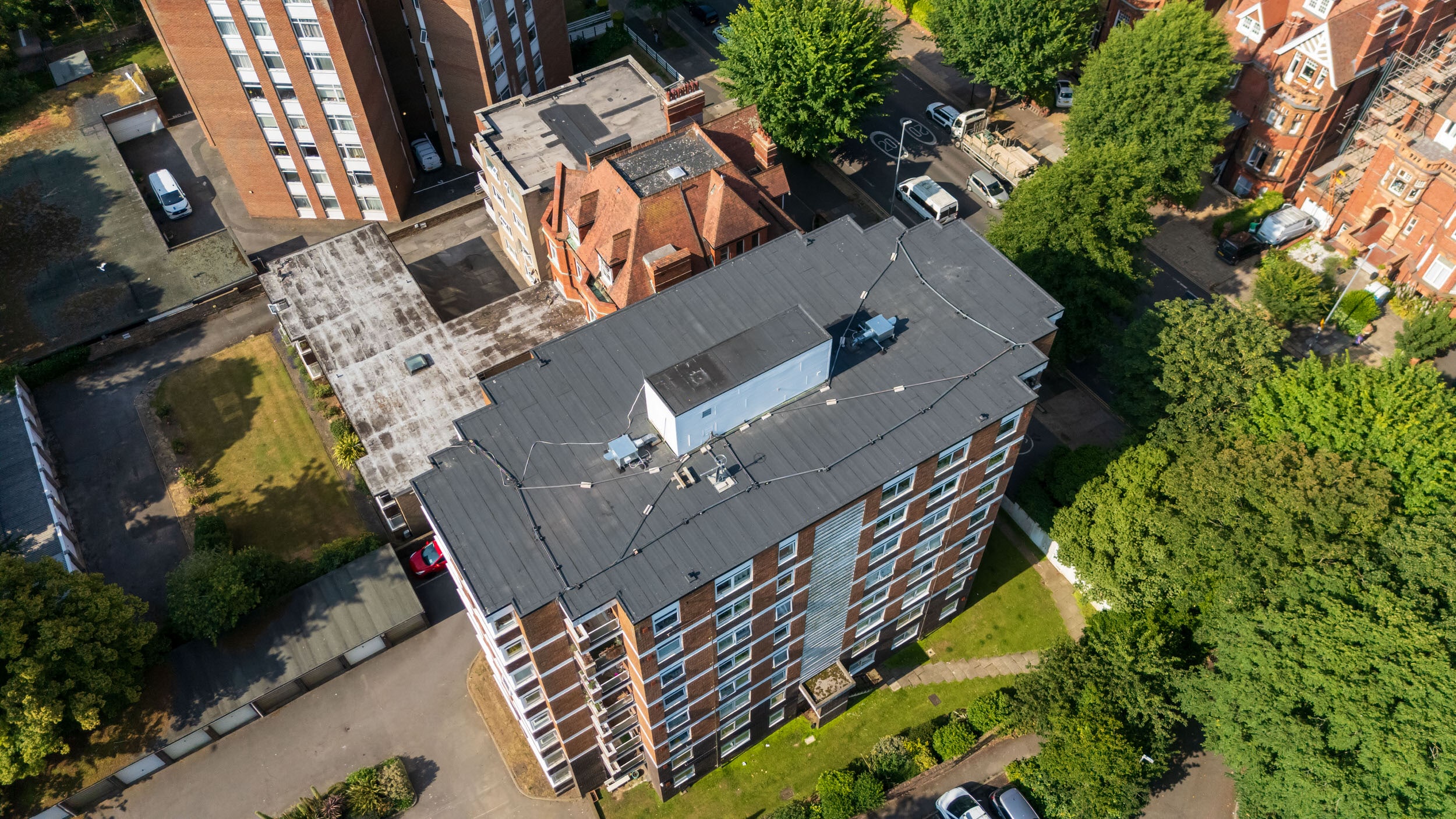
Hot melt is a monolithic waterproofing system, laid hot so that it bonds completely to the deck with no seams or laps to fail. It earns its place where a leak would be expensive and disruptive to trace, and where the waterproofing sits beneath something else: a podium deck, a roof terrace, a car park or the build up of a green roof. Because the membrane bonds fully to the substrate, water cannot track between layers, so a defect stays where it happened rather than surfacing somewhere else entirely.
Around Horsham it tends to be specified on commercial units and newer residential blocks where flat areas are large and getting back up for maintenance is awkward. It is one of our own core systems rather than something we subcontract, and we survey the deck and the existing build up before specifying it.
Or speak with our friendly team:
Nationwide Roofing Southern has been roofing across the South East for over 50 years. We are members of the National Federation of Roofing Contractors and we are CHAS accredited, with full public liability and employer’s liability insurance in place on every job and a certificate available on request. Our system warranties cover labour, materials and damage. Surveys and quotes are free, come in writing, and carry no obligation.
Or speak with our friendly team:


We keep every system in house rather than fitting the one we happen to specialise in, so the advice is about your roof and not about our kit. Around Horsham that runs from a village cottage through to a commercial unit:
Or speak with our friendly team:
If a Horsham roof is leaking, dropping tiles, or simply old enough to be worth a look before winter, the survey costs nothing. We look at the roof and the loft rather than judging it from the drive, and put in writing whether it needs replacing, repairing or leaving alone, with a price against it.
Or speak with our friendly team:
Horsham sits in the West Sussex Weald, surrounded by clay-soil farmland and woodland. Roofs here face the typical Wealden mix: westerly and south-westerly autumn gales test ridge tiles and chimney pointing on exposed properties, autumn leaf fall blocks gutters and valleys quickly, and storm-fallen branches are common after a strong blow. Frost damage to cracked pointing on older Wealden cottages is the main winter risk. Salt-related corrosion is not a factor this far inland.
Yes. Horsham has multiple conservation areas covering the historic town centre around the Causeway and parts of the Carfax, with listed buildings throughout. Some streets carry Article 4 Directions that can restrict roof shape, slope, tile material and rooflight placement. Planning consent and listed building consent are the homeowner’s responsibility. We recommend checking with Horsham District Council’s planning team before any roof work begins, and we will work to whatever specification the council approves.
Horsham’s older housing includes timber-framed and tile-hung Wealden cottages and farmhouses, plus the town’s distinctive horsham slab stone roofs on some historic properties that need specialist replacement when damaged. Victorian and Edwardian terraces and villas across the wider town use natural-slate or clay-tile pitched roofs. Newer estates and modern developments use concrete interlocking tiles, with hot melt or EPDM on flat extensions, garages and dormers. Each comes with a different maintenance pattern.
After a strong westerly or south-westerly across the Weald, look for slipped, cracked or missing tiles, dislodged ridge or hip tiles, fallen branches across roof slopes, leaf-fall and debris blocking valleys and gutters, and damp patches on top-floor ceilings or chimney breasts. Cracked horsham slab and storm-fallen tree limbs are particular risks on older Horsham properties. If you spot anything, get it covered or assessed before the next weather front arrives.
Horsham stone is a local sandstone, split into heavy slabs and laid in graded courses, and it survives on some of the district’s oldest buildings. It weighs a great deal more than clay tile, so the structure underneath was built to carry it, and problems usually begin with the timbers or the fixings rather than with the stone itself. Slabs can often be salvaged and re-laid. On a listed building the specification is tightly controlled and consent is the owner’s responsibility. If a stone roof is causing you concern, the place to start is a proper look at what is holding it up, and the survey costs nothing.
Most sound pitched roofs can, but the roof is the part worth thinking about before the panels are ordered. Mounting brackets have to be fixed through the covering into the rafters, so the condition of the timbers, battens and underlay matters, and every penetration is a potential leak if it is not flashed properly. If a roof is within a few years of needing replacement it is far cheaper to re-roof first than to remove and refit an array later. We are glad to look at a roof and tell you which of those you are dealing with.
Yes, alongside domestic work. Around Horsham that tends to mean commercial units and larger buildings with substantial flat areas, which is where a system like hot melt earns its place because there are no seams to fail and a leak stays where it happened. The process is the same as for a house: we survey the roof and what sits beneath it, then set out in writing what we found, what we would do and what it includes.
Almost never. The work happens outside and above you, and we plan it in sections so the property is closed up rather than left open. Expect noise, a skip, and scaffolding for the duration. Stripping an old roof creates dust that can find its way through a loft hatch, so it is worth clearing anything precious out of the loft beforehand and covering what stays. We agree access, parking and where materials will stand before the first morning rather than on it.
It depends on the size and complexity of the roof and on what we find once the covering is off. A straightforward semi is a different job from a rambling village property with several pitches, valleys and dormers. Weather is the other variable, and an inland winter costs more days than a dry spell does. We give a realistic range at quote stage rather than an optimistic one, and tell you as soon as anything changes it.
Usually not. Bedding ridge and hip tiles in mortar was standard for a long time and mortar has a shorter life than the tiles it holds down, so cracked and missing pointing is one of the most common things we see on older Horsham roofs. Where the covering underneath is still sound the ridge can be re-bedded, or changed to a dry fixed system that does not rely on mortar at all. It is worth dealing with before a ridge tile actually comes off.
Or speak with our friendly team:
Or speak with our friendly team:
At Nationwide Roofing Southern, we are members of the National Federation of Roofing Contractors (NFRC) and we are CHAS accredited. Our accreditations reflect our commitment to high-quality service, strict safety standards, and lasting results. Whether it’s repairs, installations, or maintenance, you can trust our skilled team to deliver reliable roofing solutions that meet industry expectations.

Cookies on this site
Essential cookies keep this site working. Everything else is optional and stays switched off until you choose.
Privacy settings
Choose which optional cookies this site may use. Each purpose below says what it does and which companies it involves.