
Nationwide Roofing Southern delivers professional roofing services across Eastbourne. With over 50 years of experience, we provide high-quality roofing solutions backed by free surveys and quotes.
Or speak with our friendly team:
Roofs in Eastbourne sit on one of the most exposed south facing stretches of the Sussex coast, with the Channel in front of them and the Downs offering no shelter from the west. Salt laden air corrodes flashings, fixings and untreated lead long before the slates or tiles themselves give up, and the autumn south westerlies find anything already loose along a ridge. A roof on the front is doing a different job from the same roof half a mile inland, so on Eastbourne work we specify to the plot rather than to the postcode.
Or speak with our friendly team:

We prioritise timely project completion with minimal disruption to your home or business, ensuring you receive dependable roofing solutions when you need them.
Our fully accredited and qualified team adheres to the highest industry standards, ensuring safe, professional roofing installations and repairs.
We use premium materials to create long-lasting, weather-resistant roofs that protect your property for years.

Eastbourne’s housing changes character within a couple of miles. Victorian seafront terraces and the large villas behind them carry natural slate with lead lined parapet gutters, where a blocked outlet backs up out of sight until it shows on a ceiling. The Edwardian and inter war streets inland run more to clay tile. Post war estates and the bungalows Eastbourne has in quantity tend to fail generally across a whole slope rather than in one spot. Modern seafront apartment blocks are mostly flat roofs on marine grade fixings. We survey before quoting because those all need different answers.
Or speak with our friendly team:
A new roof starts underneath the covering, not on top of it. We strip back, check the battens, underlay and rafters, and put right whatever the old roof was hiding before anything new goes on. On Eastbourne property that usually means replacing fixings and flashings the salt air has been working on for years. Tile, slate and flat systems are all installed to the manufacturer’s specification so the warranty actually stands behind them.
Locally, our work includes the full roofing package for St Mark’s House, a former office block being redeveloped as flats.
Roofs here tend to be replaced because the covering has aged out rather than because of one failure. Slates that slip again after every blow, mortar gone along the ridge and verge, and underlay that tears when you touch it all point the same way. We will tell you when a roof still has years left in it. When it genuinely does not, replacing it costs less than repairing the same roof over and over.
Repairs in Eastbourne are usually weather driven. Salt air works on fixings and flashings, and wind straight off the Channel lifts whatever is already loose. We trace a leak to where the water is actually getting in rather than to where it shows on the ceiling, which are often two different parts of the roof entirely. Small repairs are worth doing properly and early, before the next front comes through.
Flat roofs across Eastbourne sit on extensions, dormers, garages, balconies and a fair amount of commercial property. We install and repair felt, single ply and liquid systems, set the falls so water actually reaches the outlets, and detail the upstands and abutments properly. That is where flat roofs fail, at the edges and junctions, rather than out in the middle.
For a local example, see our slate and single ply roofing project in Eastbourne.
Natural slate on the Victorian seafront terraces, clay tile through the Edwardian and inter war streets, concrete interlocking on the newer estates. We work on all of them, salvaging and re-laying sound material where we can, and matching size, profile and colour as closely as we can source when new is needed. Weathered material never matches new exactly, and we will say so before you commit rather than after.
A green roof needs a deck that can carry the loading, the right falls, and a waterproofing layer designed to sit beneath a growing medium. On Eastbourne properties the practical candidates are usually flat areas on extensions, garages and outbuildings, and newer developments where the weight was designed in. We survey before specifying anything, and we will say plainly if a roof is not suited to one.
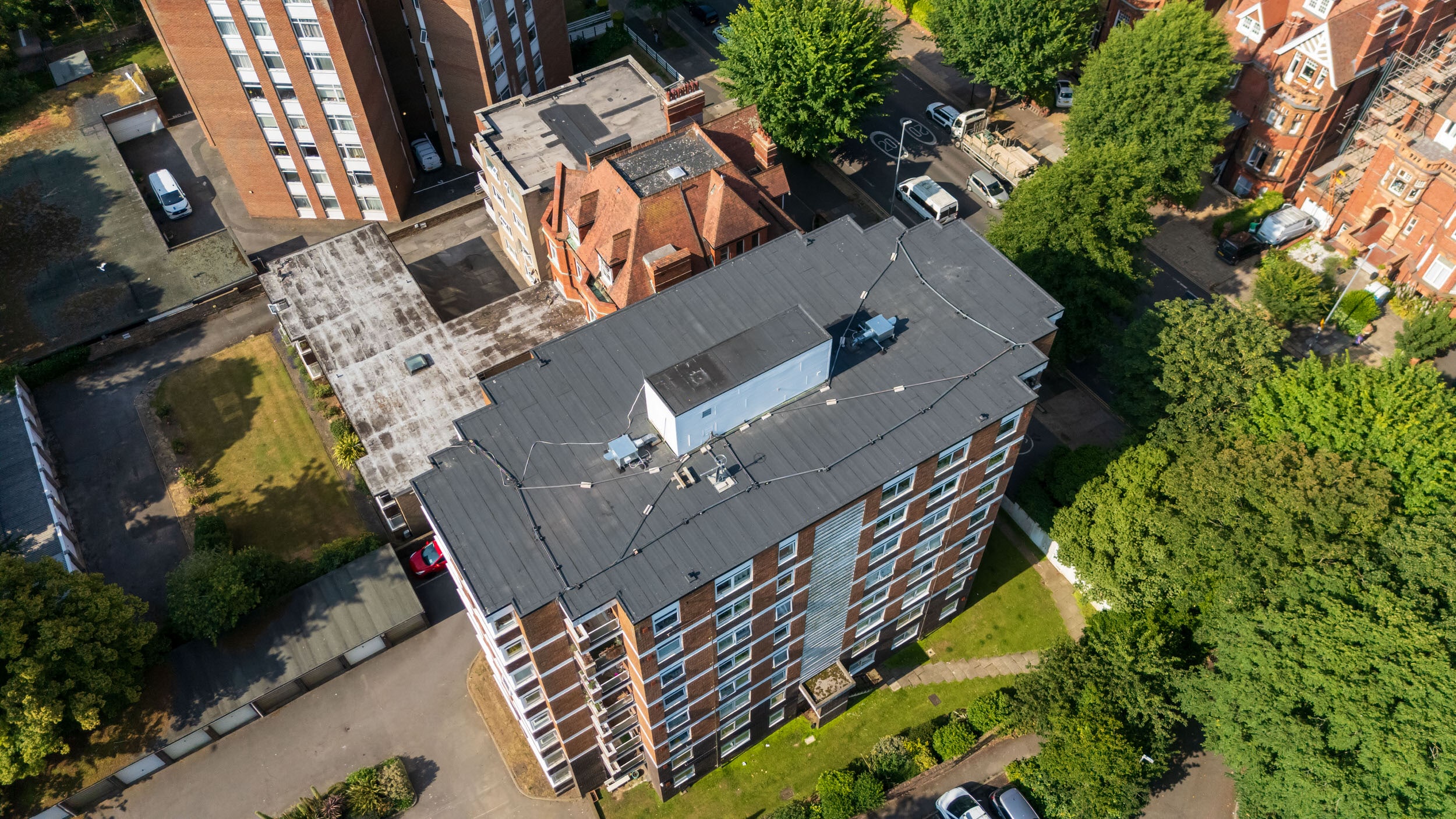
Hot melt is a monolithic waterproofing system, laid hot so that it bonds completely to the deck with no seams or laps to fail. That matters most where a leak would be expensive and disruptive to trace, and where the waterproofing sits underneath something else: a podium deck, a roof terrace, a car park or the build up of a green roof. Because the membrane bonds fully to the substrate, water cannot track between layers, so a defect stays where it happened rather than surfacing somewhere else entirely.
On Eastbourne buildings we see it specified on apartment blocks and commercial property where the flat area is large and access for future maintenance is awkward. It is one of our own core systems rather than something we subcontract out, and we survey the deck and the existing build up before specifying it.
Or speak with our friendly team:
We keep every system in house rather than fitting the one we happen to specialise in, so the advice you get is about your roof and not about our kit. Across Eastbourne that runs from a single slipped slate on a terrace through to a full flat roof replacement on a seafront block:
Or speak with our friendly team:


Nationwide Roofing Southern has been roofing across the South East for over 50 years. We are members of the National Federation of Roofing Contractors and we are CHAS accredited. Full public liability and employer’s liability insurance is in place on every job, with a certificate available on request, and our system warranties cover labour, materials and damage. Surveys and quotes are free and come in writing. If a roof does not need the work, we would sooner tell you that than sell it to you.
Or speak with our friendly team:
If an Eastbourne roof is leaking, shedding slates, or simply old enough to be worth looking at before the autumn gales arrive, the survey is the place to start and it costs nothing. We look at the roof and the loft rather than diagnosing from the pavement, tell you whether it needs replacing, repairing or leaving alone, and put that in writing with a price against it.
Or speak with our friendly team:
Eastbourne sits on the East Sussex coast at the foot of the South Downs and the start of the Seven Sisters cliffs. The town has one of the most exposed south-facing coastlines on the south coast. Salt-laden air corrodes metal flashing, fixings and untreated lead faster than further inland, and south-westerly autumn gales test ridge tiles, slate clips and chimney pointing hard. The Downs and Beachy Head to the west offer no shelter from coastal winds. We specify marine-grade fixings and account for the corrosive coastal environment on every Eastbourne job.
Yes. Eastbourne has multiple conservation areas covering the historic seafront, Meads, the Old Town, Upperton and several historic streets, with listed buildings throughout including parts of the Victorian seafront and pier. Conservation area rules and listed building consent are the homeowner’s responsibility and can restrict roof shape, slope, tile material and rooflight placement. We recommend checking with Eastbourne Borough Council’s planning team before any roof work begins, and we will work to whatever specification the council approves.
Eastbourne’s housing stock includes Victorian seafront terraces and large detached villas with natural-slate pitched roofs and lead-lined parapet gutters, Edwardian and inter-war housing across the town, post-war estates and modern seafront apartment blocks. Pitched roofs typically use clay tile or natural slate, with concrete interlocking tiles on newer developments. Flat roofs on extensions, garages and apartments are usually hot melt or EPDM, often with marine-grade fixings. Bungalows are particularly common across Eastbourne’s residential estates. Each comes with a different maintenance pattern.
After a strong southerly or south-westerly off the Channel, look for slipped, cracked or missing slates and tiles, dislodged ridge or hip tiles, debris in valley gutters and parapet boxes, and damp patches on top-floor ceilings or chimney breasts. Salt-corroded fixings on older lead flashing are a particular vulnerability on Eastbourne seafront and Meads properties. If you spot anything, get it covered or assessed before the next weather front arrives.
Yes. A single slipped or cracked slate, a localised flat roof defect or storm damage to one section is worth putting right on its own, and replacing isolated tiles is often more sensible than larger work when the rest of the roof is sound. We survey first so you know whether the problem is isolated or part of a wider pattern. Full public liability and employer’s liability insurance is in place on every job, and a current certificate is available on request before work starts.
Age, the extent of the damage and whether the problem is isolated or widespread all decide it. A Victorian slate roof on an Eastbourne seafront terrace with sound timbers and a few failed fixings is usually a repair; the same roof with widespread slate delamination and repeated leaks is not. We give an honest assessment either way after a free survey. Replacements carry a workmanship warranty from us plus the manufacturer’s warranty on the tiles, slates or membrane, confirmed in writing with your quote.
A description of what you are seeing, the property address and a few photographs of the affected area and any internal water staining. That lets us judge the likely cause, the access needed and whether scaffolding is required before anyone arrives. On exposed seafront and Meads properties access is often the factor that shapes how soon work can start, so it helps to say how many storeys the property is and whether there is side or rear access.
Pitched roofs in clay tile and natural slate, flat roofing and waterproofing including hot melt systems, green roofs, and complete new roof installations and re-roofing across Eastbourne and the surrounding East Sussex coast. Work runs from repairs and weather damage through to full replacement on Victorian and Edwardian housing, post-war estates, bungalows and modern seafront apartment blocks. Over 50 years of roofing experience sits behind the specification on each.
Yes. Flat areas on extensions, garages, dormers and apartment balconies are among the most common jobs on this stretch of coast, and they are also where salt air and standing water do the most damage. We cover flat roofing and waterproofing on them, including hot melt systems, and we survey the existing build up, falls and outlets before recommending anything. Marine grade fixings and properly detailed upstands matter more here than they do inland.
Often, yes. A green roof needs a structurally suitable deck, the right falls and a waterproofing layer designed to sit beneath a growing medium, so it starts with a survey rather than a specification. On Eastbourne properties the practical candidates are usually flat areas on extensions, garages and outbuildings, and newer developments where the deck was designed with the loading in mind. Green roofs are one of our core systems, and we will say plainly if a roof is not suited to one.
Or speak with our friendly team:
Or speak with our friendly team:
At Nationwide Roofing Southern, we are members of the National Federation of Roofing Contractors (NFRC) and we are CHAS accredited. Our accreditations reflect our commitment to high-quality service, strict safety standards, and lasting results. Whether it’s repairs, installations, or maintenance, you can trust our skilled team to deliver reliable roofing solutions that meet industry expectations.

Cookies on this site
Essential cookies keep this site working. Everything else is optional and stays switched off until you choose.
Privacy settings
Choose which optional cookies this site may use. Each purpose below says what it does and which companies it involves.