
Nationwide Roofing Southern provides reliable roofing services across Hailsham. With over 50 years of experience, we offer tailored roofing solutions with free surveys and quotes.
Or speak with our friendly team:
Hailsham looks like an inland town on a map and does not behave like one on a roof. Between here and the sea lie the Pevensey Levels, flat open marshland with almost nothing standing on it, so wind coming off the Channel crosses that ground barely slowed and arrives with much of its strength intact. The result is a town that gets coastal style wind loading without the salt that usually comes with it, and roofs that lose material in a blow more readily than their position suggests they should.
Or speak with our friendly team:

We prioritise timely project completion with minimal disruption to your home or business, ensuring you receive dependable roofing solutions when you need them.
Our fully accredited and qualified team adheres to the highest industry standards, ensuring safe, professional roofing installations and repairs.
We use premium materials to create long-lasting, weather-resistant roofs that protect your property for years.

We keep every system in house rather than fitting the one we happen to specialise in, so the advice is about your roof and not about our kit:
Or speak with our friendly team:
A new roof starts underneath the covering. We strip back, check the battens, underlay and rafters, and put right whatever the old roof was hiding before anything new goes on. On an exposed Hailsham roof the fixing specification is not a detail, it is most of the argument, so it is set for the exposure rather than for the minimum. Everything is laid to the manufacturer’s specification so the warranty stands behind it.
Roofs here get replaced because wind has steadily worked them loose rather than because of one failure. Tiles lifting at the verge, ridge mortar cracked and gone, underlay torn where it has been flapping for years. A re-roof is also the only moment when the fixings, the insulation and the ventilation can all be brought up to current standards at once. We will tell you honestly when a roof still has years left in it.
Most of what we are called to here follows a gale: tiles gone from a verge or a ridge, a section of covering lifted, flashings pulled away at an abutment. We trace a leak to where the water is getting in rather than to where it shows on the ceiling. Where a roof has lost material it is worth having the rest of the run checked at the same time, because wind rarely takes only the one tile it has loosened.
Flat roofs around Hailsham sit on extensions, garages, porches and dormers across the estates. We install and repair felt, single ply, EPDM and GRP fibreglass systems, set the falls so water reaches the outlets rather than standing, and detail the upstands and trims properly. On an exposed site the perimeter trim is the part that matters, because that is where wind gets under a flat covering and lifts it.
In the town itself we renewed the flat roof at Hailsham Memorial Institute.
Clay tile and slate on the older town property, concrete interlocking across the estates. We match size, profile and colour as closely as we can source when new material is needed, and weathered material never matches new exactly, so we say so before you commit. On a wind exposed elevation how a tile is fixed matters as much as which tile it is, because a correctly fixed roof and a nominally fixed one look identical until it blows.
A green roof needs a deck that will carry the loading, the right falls, and a waterproofing layer designed to sit beneath a growing medium. Around Hailsham the practical candidates are usually flat areas on extensions, garages and outbuildings, and newer development where the weight was designed in from the start. Exposure matters here too, since a green roof build up has to be detailed so wind cannot get at its edges. We survey before specifying anything.
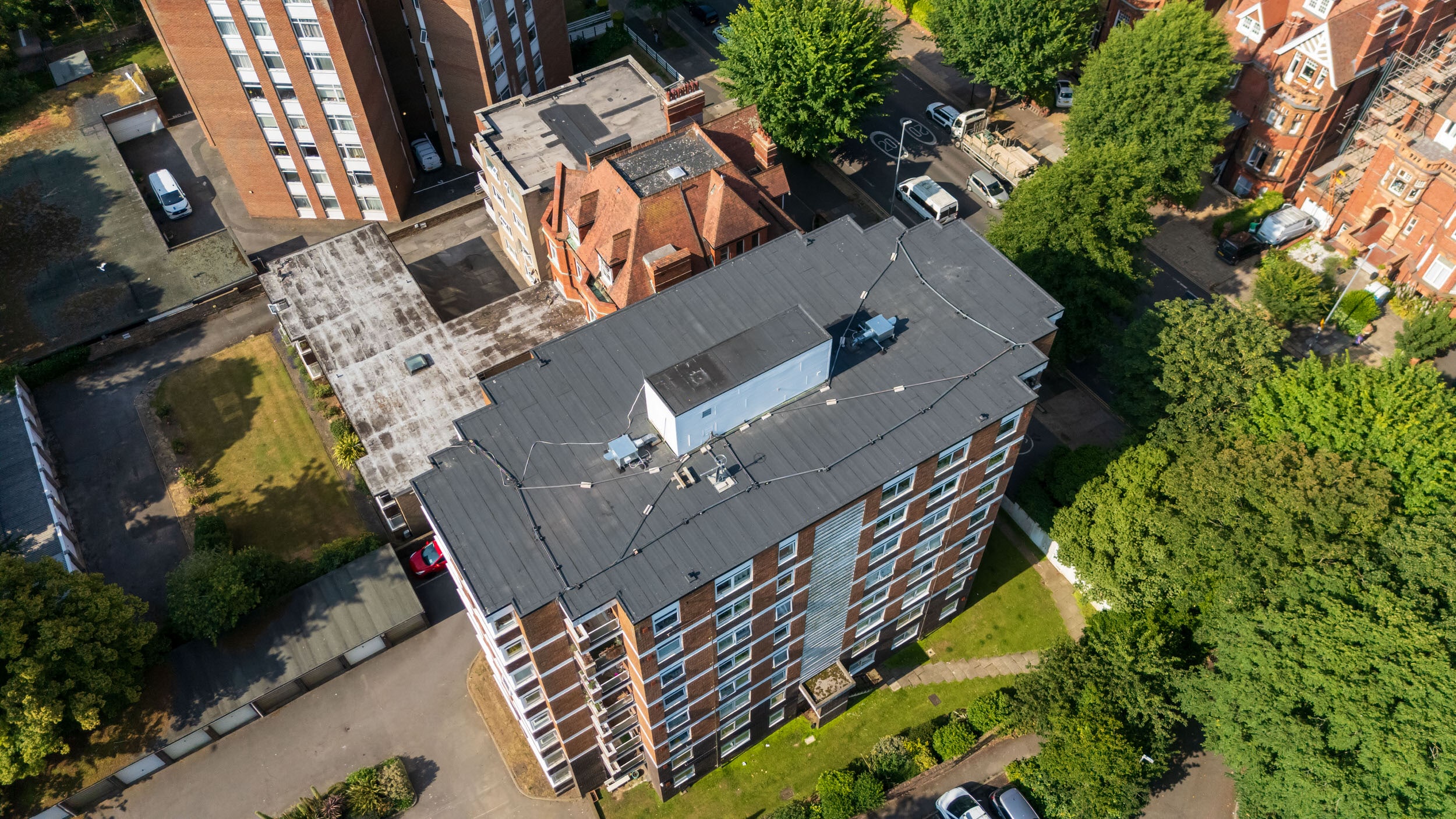
Hot melt is a monolithic waterproofing system, laid hot so that it bonds completely to the deck with no seams or laps to fail. It earns its place where a leak would be expensive and disruptive to trace, and where the waterproofing sits beneath something else: a podium deck, a roof terrace, a car park or the build up of a green roof. Because the membrane bonds fully to the substrate, water cannot track between layers, so a defect stays where it happened rather than surfacing somewhere else entirely.
Bonding fully to the deck also means there is nothing loose for wind to catch, which matters on an exposed site. Around Hailsham it suits larger flat areas on commercial buildings and any roof carrying something above the waterproofing. It is one of our own core systems rather than something we subcontract.
Or speak with our friendly team:
The historic centre is modest and the rest of Hailsham is expansion: substantial estate development from the nineteen sixties onwards, still going, laid mostly in concrete interlocking tile. That gives the town two quite different roofing populations. The older property has mortar bedded ridges and verges at the end of a long life, and the estate housing has roofs of a similar age to each other, built to the standards of their day, now reaching the point where the fixings rather than the tiles decide how they cope with a gale.
Or speak with our friendly team:


Nationwide Roofing Southern has been roofing across the South East for over 50 years. We are members of the National Federation of Roofing Contractors and we are CHAS accredited, with full public liability and employer’s liability insurance in place on every job and a certificate available on request. Our system warranties cover labour, materials and damage. Surveys and quotes are free, come in writing, and carry no obligation.
Or speak with our friendly team:
If a Hailsham roof has lost tiles in a blow, has a ridge line looking uneven, or is simply old enough to be worth a proper look, the survey costs nothing. We look at the roof and the loft rather than judging it from the pavement, and put in writing what we found, what we would do and what it includes.
Or speak with our friendly team:
Hailsham sits on the edge of the Sussex Weald, with Pevensey Levels and the coast a short distance to the south. Roofs here see mainly inland pressures: westerly and south-westerly autumn gales test ridge tiles and chimney pointing on exposed properties, and heavy tree cover across the wider parish means autumn leaf fall blocks gutters and valleys quickly. Salt-related corrosion is a minor factor at most, only on properties closest to the Pevensey Levels. Frost damage to cracked pointing on older Wealden cottages is the main winter risk.
Yes. Hailsham has a designated conservation area covering the historic town centre around the town centre, with listed buildings throughout including the parish church. Conservation area rules and listed building consent are the homeowner’s responsibility and can restrict roof shape, slope, tile material and rooflight placement. We recommend checking with Wealden District Council’s planning team before any roof work begins, and we will work to whatever specification the council approves.
Hailsham’s housing stock spans timber-framed and tile-hung cottages in the older streets with clay-tile or peg-tile pitched roofs, Victorian and Edwardian terraces near the town centre with natural-slate or clay-tile pitched roofs, plus large post-war estates and modern developments on the town’s edges using concrete interlocking tiles. Flat roofs on extensions, garages and dormers are usually hot melt or EPDM. Each comes with a different maintenance pattern.
After a strong westerly or south-westerly across the Weald, look for slipped, cracked or missing tiles, dislodged ridge or hip tiles, fallen branches across roof slopes, leaf-fall and debris blocking valleys and gutters, and damp patches on top-floor ceilings or chimney breasts. Lifted lead flashing around chimneys is common on older Hailsham properties after a strong blow. If you spot anything, get it covered or assessed before the next weather front arrives.
Less than the map suggests. The Pevensey Levels sit between the town and the sea: flat, open marshland with very little standing on it, so wind off the Channel crosses that ground barely slowed. Hailsham gets close to coastal wind loading without the salt that normally accompanies it. In practice that means the tiles here tend to outlast the things holding them down, and roofs lose material in a gale more readily than their position would lead you to expect.
It lifts rather than pushes, which surprises people. Air flowing over a roof creates suction on the surface, strongest at the edges, the verges, the ridge and the corners, so those are where tiles go first and why damage starts at the perimeter and works inwards. It also works cumulatively: a tile that has been rocking slightly for years is not damaged until the day it goes. That is why a roof can survive a dozen storms and then lose a whole section in one that was not obviously worse.
Because they sit at the exposed edges where the suction is greatest, and because traditionally they were held on with mortar, which has a shorter working life than the tiles themselves. Once the pointing cracks the fixing is doing little. A dry verge system replaces the mortar at the gable edge with mechanically fixed caps, so the verge is held down rather than stuck down, and there is nothing to crack out. On an exposed Hailsham roof that is usually the sensible answer rather than re-pointing and waiting.
Yes, and mostly through how it is fixed rather than what it is covered with. Fixing specification is set according to exposure, so a roof on open ground should be specified differently from the same roof in a sheltered street. Mechanically fixing ridges and verges rather than bedding them in mortar, and increasing how many tiles are individually fixed on the vulnerable elevations, are the two things that make the biggest difference. It costs very little extra at the point of installation and a great deal to retrofit after a gale.
Stay off the roof and keep clear of the ground below it, because a tile that is already loose will come down without warning. Photograph what you can see from ground level, note where the missing ones were, and get the rest of the run checked rather than only the gap. Wind almost never takes just the one tile it has loosened, so what looks like a small repair is often a section that has moved. Getting it looked at before the next blow is the difference between replacing tiles and replacing a ceiling.
Where a substantial part of a roof is being replaced, yes, building regulations expect it to be brought up to current requirements rather than put back exactly as it was. In practice that mostly concerns insulation and ventilation, and it is one of the reasons a re-roof is not simply a like for like swap of the covering. It is worth knowing before you compare quotes, because a price that leaves those out is not the same job as one that includes them, and the difference is invisible once the tiles are on.
Or speak with our friendly team:
Or speak with our friendly team:
At Nationwide Roofing Southern, we are members of the National Federation of Roofing Contractors (NFRC) and we are CHAS accredited. Our accreditations reflect our commitment to high-quality service, strict safety standards, and lasting results. Whether it’s repairs, installations, or maintenance, you can trust our skilled team to deliver reliable roofing solutions that meet industry expectations.

Cookies on this site
Essential cookies keep this site working. Everything else is optional and stays switched off until you choose.
Privacy settings
Choose which optional cookies this site may use. Each purpose below says what it does and which companies it involves.