
Nationwide Roofing Southern offers professional roofing services across Portsmouth. With over 50 years of expertise, we provide tailored solutions with free surveys and quotes.
Or speak with our friendly team:
We keep every system in house rather than fitting the one we happen to specialise in, so the advice is about your roof and not about our kit. Across Portsmouth that runs from one slipped slate on a terrace through to a full flat roof replacement on a block:
Or speak with our friendly team:

We prioritise timely project completion with minimal disruption to your home or business, ensuring you receive dependable roofing solutions when you need them.
Our fully accredited and qualified team adheres to the highest industry standards, ensuring safe, professional roofing installations and repairs.
We use premium materials to create long-lasting, weather-resistant roofs that protect your property for years.

Portsmouth is one of the most densely built cities in the country and most of it is terraced, so on a mid terrace property the roof is continuous with the houses either side. Shared valleys, party walls and abutments all have to be worked out before a price means anything, and the scaffold has to go somewhere, which on a terraced street often means the pavement or a neighbour’s ground. We settle all of that at survey rather than discovering it on the first morning.
Or speak with our friendly team:
A new roof begins underneath the covering. We strip back, check the battens, underlay and rafters, and put right whatever the old roof was hiding before anything new is laid. On a Portsmouth terrace that often means renewing the lead at the valleys and abutments where the roof meets next door, because that junction is where the next leak would otherwise start. Everything is installed to the manufacturer’s specification so the warranty stands behind it.
Most Portsmouth re-roofs happen because the covering has simply aged out. Slates that slip again every winter, mortar gone from the ridge, and underlay that tears at a touch all say the same thing. On a terrace we plan the run and the scaffold before starting, and where neighbours are doing the same work it is usually cheaper and less disruptive to do it as one job than as two.
We trace a leak to where water is getting in rather than to where it appears on the ceiling, which on a terrace can be two properties apart. Valleys, lead flashings and abutments account for most of what we are called to here, along with wind damage after a blow off the Solent. Small repairs done properly and early cost a great deal less than the ceiling that follows if they are left.
Flat roofs across Portsmouth sit on rear extensions, dormers, garages, balconies and a good deal of commercial property. We install and repair felt, single ply and liquid systems, set the falls so water actually reaches the outlets, and detail the upstands and abutments properly. Flat roofs fail at their edges and junctions rather than out in the middle, so that detailing is the job.
Natural slate across the Victorian and Edwardian terraces, clay and concrete tile on the newer estates. We salvage and re-lay sound material where we can, and match size, profile and colour as closely as we can source when new is needed. On a terrace that matters more than usual, because the roofline is continuous and visible from the street, and a patch shows. Weathered material never matches new exactly and we say so up front.
A green roof needs a deck that will carry the loading, the right falls, and a waterproofing layer designed to sit beneath a growing medium. In Portsmouth the practical candidates are usually flat areas on extensions, garages and outbuildings, and newer developments where the weight was designed in from the start. We survey before specifying anything and will say plainly if a roof is not suited to one.
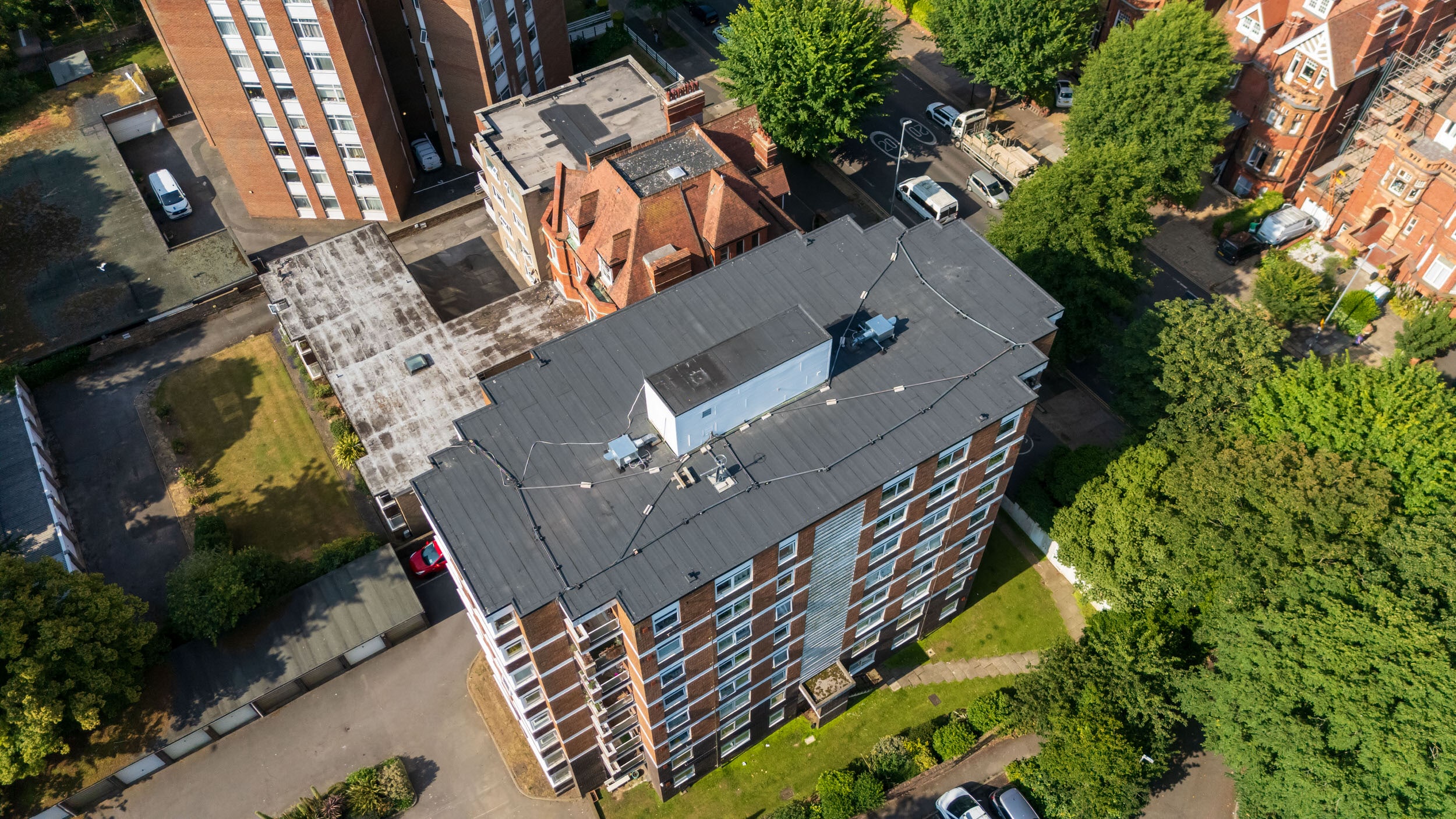
Hot melt is a monolithic waterproofing system, laid hot so that it bonds completely to the deck with no seams or laps to fail. It earns its place where a leak would be expensive and disruptive to trace, and where the waterproofing sits beneath something else: a podium deck, a roof terrace, a car park or the build up of a green roof. Because the membrane bonds fully to the substrate, water cannot track between layers, so a defect stays where it happened instead of appearing somewhere else entirely.
Across Portsmouth it tends to be specified on apartment blocks and commercial property, where flat areas are large and getting back up there for maintenance is awkward. It is one of our own core systems rather than something we subcontract, and we survey the deck and the existing build up before specifying it.
Or speak with our friendly team:
Nationwide Roofing Southern has been roofing across the South East for over 50 years. We are members of the National Federation of Roofing Contractors and we are CHAS accredited. Full public liability and employer’s liability insurance is in place on every job, which matters more than usual when the work sits against someone else’s property, and a certificate is available on request. Our system warranties cover labour, materials and damage, confirmed in writing with the quote.
Or speak with our friendly team:


The island runs mostly to Victorian and Edwardian terraces in natural slate, with valleys and lead flashings where one roof meets the next. Southsea adds dormers and flat roofed rear extensions in quantity. Further out there are post war estates and blocks of flats where the roof is a shared structure rather than one household’s problem. Almost all of it sits within a mile or two of salt water, so fixings and flashings age faster here than the coverings above them.
Or speak with our friendly team:
If a Portsmouth roof is leaking, dropping slates, or simply old enough to be worth checking, the survey costs nothing and is the sensible place to start. We look at the roof and the loft rather than diagnosing it from the street, work out the access while we are there, and put in writing whether it needs replacing, repairing or leaving alone.
Or speak with our friendly team:
Portsmouth sits on Portsea Island on the Hampshire coast, surrounded on three sides by water and only partly sheltered by the Isle of Wight. Salt-laden air corrodes metal flashing, fixings and untreated lead faster than further inland, particularly on waterfront and seafront properties. South-westerly autumn gales come up the Solent with little to break them and test ridge tiles, slate clips and chimney pointing hard. Urban density adds to moss and algae growth on shaded slopes. We specify marine-grade fixings on every Portsmouth job.
Yes. Portsmouth has multiple conservation areas, including Old Portsmouth, Southsea, Spice Island, Eastney and several historic streets, with listed buildings throughout including parts of the dockyard and the historic seafront. Some have Article 4 Directions or listed building protections that can restrict roof shape, slope, tile material and rooflight placement. Planning consent and listed building consent are the homeowner’s responsibility. We recommend checking with Portsmouth City Council’s planning team before any roof work begins, and we will work to whatever specification the council approves.
Portsmouth’s housing stock includes Victorian terraces across central districts and Southsea with natural-slate or clay-tile pitched roofs, post-war reconstructions following Second World War bombing, large inter-war and post-war suburban stocks, plus modern seafront and waterfront apartment blocks. Pitched roofs typically use clay tile or natural slate, with concrete interlocking tiles on newer developments. Flat roofs are usually hot melt or EPDM, often with marine-grade fixings. Each comes with a different maintenance pattern.
After a strong south-westerly up the Solent, look for slipped, cracked or missing slates and tiles, dislodged ridge or hip tiles, debris in valley gutters and parapet boxes, and damp patches on top-floor ceilings or chimney breasts. Salt-corroded fixings on older lead flashing are a particular vulnerability on Portsmouth seafront and dockyard-area properties. If you spot anything, get it covered or assessed before the next weather front arrives.
Portsmouth is largely terraced, and on a mid-terrace property the roof is continuous with the houses either side, so the work is planned around that. We check where the shared valleys, party walls and abutments fall before quoting, and we agree in advance where scaffolding will stand and whether it needs to cross a neighbour’s boundary or the pavement. Full public liability and employer’s liability insurance is in place on every job, which matters when work sits this close to someone else’s property, and a certificate is available on request.
Access is usually the biggest single factor here. On a dense terraced street it decides where a scaffold can stand, whether the pavement or a neighbour’s garden is involved and how long the setup takes, and that can matter more than the roof covering itself. Beyond access, the pitch, the covering, whether battens and membrane need replacing once the roof is stripped, and the extent of the damage all move it. We survey and quote in writing so the drivers are visible rather than buried.
Most roofs give warning before water appears inside. Look for mortar crumbling from ridge and hip lines, slates that have slipped or turned, lead flashing lifted or split at an abutment, sagging between rafters, staining around a chimney breast or where a valley runs, and grit collecting below a felt roof as it breaks down. On an exposed island city these tend to show first on the elevations facing the prevailing wind.
Stripping the existing covering back, checking the timbers and replacing any that have failed, then re-laying with new battens, a breathable membrane and either the original materials where they can be salvaged or new ones. On a terrace we take particular care at the shared valleys and abutments, because that is where a neighbouring roof meets yours and where leaks usually begin. The work carries a workmanship warranty from us plus the manufacturer’s warranty on the tiles, slates or membrane, both confirmed in writing with your quote.
Usually, and on a terrace it matters because the roofline is continuous and visible from the street. Where the existing slates or tiles are sound we salvage and reuse what we can, and where new material is needed we source as close a match as we can find on size, profile and colour. Weathered material never matches new exactly, so we will tell you plainly how the finished roof is likely to look before you commit to anything.
Roofing is weather dependent and Portsmouth gets its share of wind off the Solent. We plan the work in stages so the roof can be closed up as we go rather than left open, and if conditions turn we cover and secure whatever is exposed before stopping. The aim is always to have the roof watertight before the team leaves, and you are told when work will pause and when it is expected to resume.
Or speak with our friendly team:
Or speak with our friendly team:
At Nationwide Roofing Southern, we are members of the National Federation of Roofing Contractors (NFRC) and we are CHAS accredited. Our accreditations reflect our commitment to high-quality service, strict safety standards, and lasting results. Whether it’s repairs, installations, or maintenance, you can trust our skilled team to deliver reliable roofing solutions that meet industry expectations.

Cookies on this site
Essential cookies keep this site working. Everything else is optional and stays switched off until you choose.
Privacy settings
Choose which optional cookies this site may use. Each purpose below says what it does and which companies it involves.