
Nationwide Roofing Southern delivers quality roofing services across Littlehampton. With over 50 years of experience, we offer tailored roofing solutions with free surveys and quotes.
Or speak with our friendly team:
Littlehampton sits where the Arun meets the sea, and roofs along that stretch of the West Sussex coast are worked on by wind and salt air far more than by anything else. Fixings corrode, mortar washes out and flashings lift long before the tiles themselves give up. Nationwide Roofing Southern has been roofing this coast for over 50 years, on houses and commercial premises, and every project carries insurance guarantees.
Or speak with our friendly team:

We prioritise timely project completion with minimal disruption to your home or business, ensuring you receive dependable roofing solutions when you need them.
Our fully accredited and qualified team adheres to the highest industry standards, ensuring safe, professional roofing installations and repairs.
We use premium materials to create long-lasting, weather-resistant roofs that protect your property for years.

Roofing in Littlehampton covers the older property near the front, the residential streets behind it and the commercial and light industrial units inland. We take on pitched and flat work, repairs and full replacements, so the specification can follow the exposure. Our main services include:
Or speak with our friendly team:
A new roof in Littlehampton is specified for the coast rather than to a standard inland detail. Clipping, underlay choice and the grade of fixing all change when a roof is this exposed. We strip back, check and replace battens and timbers where needed, then re-cover in tile, slate or metal to suit the building, finishing fascias, soffits and rainwater goods at the same time.
Coastal roofs in Littlehampton tend to need replacing sooner than inland ones. Corroded nails, mortar gone from the ridge and verges, and underlay perished by wind and damp are the usual findings once the covering comes off. We strip and re-cover in sections so the property stays weathertight, and put insulation and ventilation right while the roof is open.
Repairs in Littlehampton usually follow weather. Wind lifts a tile or a verge and takes its neighbours with it, and driven rain gets behind flashings that have worked loose. We make the roof safe first, trace the water back to where it is actually entering, and repair the covering, flashings or leadwork properly rather than sealing the nearest gap.
Flat roofs in Littlehampton fail at the edges more often than in the middle, because wind uplift finds any weak perimeter fixing. We install and repair single ply, felt and liquid systems on extensions, garages, dormers and commercial buildings, set falls so water clears to the outlets, and give the perimeter detail the attention it needs on an exposed site.
Pitched roofing in Littlehampton means re-tiling and re-slating, new battens and underlay, rebuilt ridges, hips and valleys, and renewed leadwork at chimneys and abutments. Mortar bedding has a short life this close to the sea, so dry ridge and dry verge systems are usually the better recommendation than bedding it again.
Green roofs can work on Littlehampton buildings, provided the planting is chosen for salt and exposure rather than picked off a standard list. We build the full make up, from waterproofing and root barrier through drainage layer, substrate and planting, and check the structure will take the loading before specifying anything.
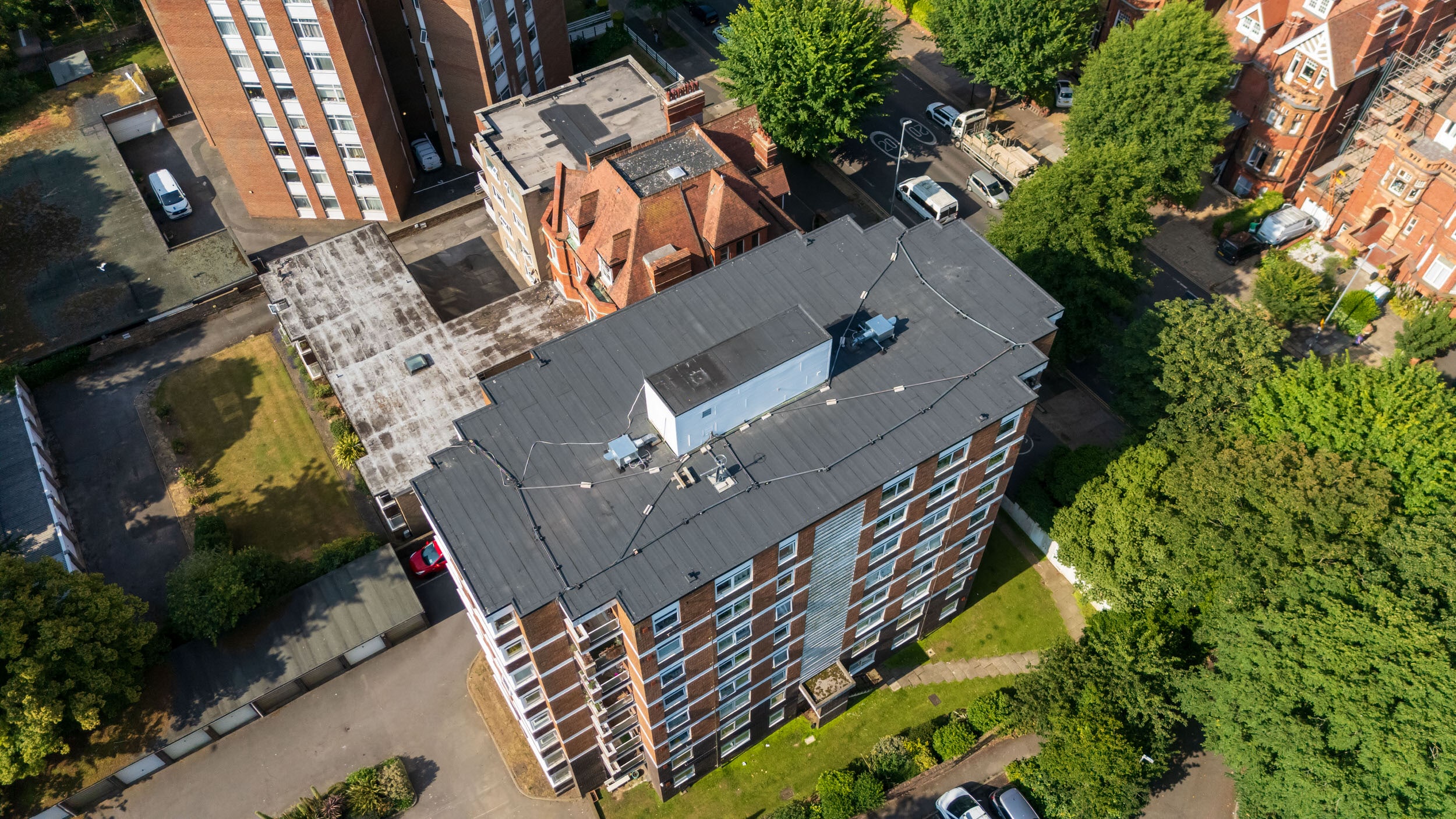
Hot melt is a monolithic waterproofing system for Littlehampton flat roofs, podium decks and green roof build ups. It is poured hot and bonds directly to the deck, leaving no seams for water to travel along. That counts most where the waterproofing is buried under paving, ballast or planting, because a leak in a seamed system can appear far from the actual fault.
We install hot melt on commercial and residential property in Littlehampton, taking in survey, deck preparation, membrane, insulation and the finish above. On an exposed coastal roof the upstand, outlet and threshold detailing is what determines the lifespan.
It is not right for every flat roof. Hot melt needs a sound structural deck and is a heavier job than recovering a small felt roof, so on a domestic extension single ply or a liquid system is often more sensible. We will tell you which suits your roof.
Or speak with our friendly team:
People in Littlehampton use Nationwide Roofing Southern because:
Or speak with our friendly team:


A Littlehampton roofing job runs in a set order:
Or speak with our friendly team:
If a roof in Littlehampton has lost tiles, started leaking or has not been looked at since the last run of bad weather, book a survey. We will tell you whether it needs replacing, repairing or leaving alone, and put it in writing with a price. Contact us for a free roof survey and quote.
Or speak with our friendly team:
Littlehampton sits on the West Sussex coast at the mouth of the River Arun, with open Channel exposure. Salt-laden air corrodes metal flashing, fixings and untreated lead faster than further inland, and south-westerly autumn gales sweep in off the sea and test ridge tiles, slate clips and chimney pointing on every roof in the town. The river estuary setting brings additional damp on north-facing slopes. We specify marine-grade fixings and account for the corrosive coastal environment on every Littlehampton job.
Yes. Littlehampton has conservation areas covering parts of the seafront, the harbour and several historic streets, with listed buildings throughout. Conservation area rules and listed building consent are the homeowner’s responsibility and can restrict roof shape, slope, tile material and rooflight placement. We recommend checking with Arun District Council’s planning team before any roof work begins, and we will work to whatever specification the council approves.
Littlehampton’s housing stock spans Victorian and Edwardian seafront terraces with natural-slate or clay-tile pitched roofs, inter-war semis and detached villas, post-war estates and modern seafront apartment blocks. Pitched roofs typically use clay tile or natural slate, with concrete interlocking tiles on newer developments. Flat roofs on extensions, garages and apartment blocks are usually hot melt or EPDM, often with marine-grade fixings throughout. Each comes with a different maintenance pattern.
After a strong southerly or south-westerly off the Channel, look for slipped, cracked or missing slates and tiles, dislodged ridge or hip tiles, debris in valley gutters and parapet boxes, and damp patches on top-floor ceilings or chimney breasts. Salt-corroded fixings on older lead flashing are a particular vulnerability on Littlehampton seafront and harbour-side properties. If you spot anything, get it covered or assessed before the next weather front arrives.
Access, the extent of the damage and the covering involved. On the older terraces near the front, getting a scaffold up can matter more to the price than the tiles do. Corroded fixings and perished flashing often turn a single slipped slate into a wider repair once the roof is opened up. The survey establishes the full extent before we put a written quote in, so you are pricing the whole job rather than the part visible from the pavement.
It depends on the roof, the system going on and the weather window. Coastal work carries more weather risk than inland work, because wind off the Channel stops safe working at height sooner than rain does, and a job here can pause on a day that would be workable further inland. We give an expected duration with the quote and say what would extend it, rather than promise a date the weather may not allow.
Late spring to early autumn gives the most settled conditions, and that is when most planned re-roofing is booked. Repairs are a different matter and should not wait for a season. The local pattern is that damage shows itself in the first hard south westerly of the autumn, when ridge tiles and flashing loosened over the summer finally give. Getting a survey done before that point is the cheaper end of the problem.
Access is settled before anything else. On the residential streets behind the seafront there is usually room for a standard scaffold to the elevation being worked on. Property fronting the coast and the older terraces are tighter, and that shapes both the programme and the order the roof is stripped in. Scaffolding and timing are agreed at survey stage. We carry public liability and employer’s liability insurance, and can provide a current certificate before work starts.
Contain the water indoors, move what you can clear of it, and do not go up to look while the wind is still up. Working at height on a wet roof in a south westerly is genuinely dangerous, and a leak rarely starts directly above the point where it shows on the ceiling. Once conditions allow, a survey traces it properly. On coastal property the origin is often perished flashing or a corroded fixing rather than the tile that looks wrong from the ground.
Yes. Alongside the housing there is commercial and light industrial property inland of the town, and that work is mostly flat rather than pitched. We install hot melt and other flat roof systems, and fit sedum and biodiverse green roofs where the structure suits one. The same survey, written quote and warranty arrangement applies whether it is a house near the front or a unit on a trading estate.
Or speak with our friendly team:
Or speak with our friendly team:
At Nationwide Roofing Southern, we are members of the National Federation of Roofing Contractors (NFRC) and we are CHAS accredited. Our accreditations reflect our commitment to high-quality service, strict safety standards, and lasting results. Whether it’s repairs, installations, or maintenance, you can trust our skilled team to deliver reliable roofing solutions that meet industry expectations.

Cookies on this site
Essential cookies keep this site working. Everything else is optional and stays switched off until you choose.
Privacy settings
Choose which optional cookies this site may use. Each purpose below says what it does and which companies it involves.