
Nationwide Roofing Southern delivers professional roofing services across Southampton. With over 50 years of experience, we provide tailored roofing solutions with free surveys and quotes.
Or speak with our friendly team:
Southampton was among the most heavily bombed cities in the country, and its roofs still show it. A Victorian or Edwardian terrace often sits directly beside post war infill built to replace what was lost, so two properties a few metres apart can have completely different roofs: natural slate on a steep pitch next to a shallow pitched or flat roofed rebuild. Neighbours comparing quotes are frequently not comparing the same job at all, and that is worth knowing before anyone assumes a price.
Or speak with our friendly team:

We prioritise timely project completion with minimal disruption to your home or business, ensuring you receive dependable roofing solutions when you need them.
Our fully accredited and qualified team adheres to the highest industry standards, ensuring safe, professional roofing installations and repairs.
We use premium materials to create long-lasting, weather-resistant roofs that protect your property for years.

We keep every system in house rather than fitting the one we happen to specialise in, so the advice is about your roof and not about our kit:
Or speak with our friendly team:
A new roof starts underneath the covering. We strip back, check the battens, underlay and rafters, and put right whatever the old roof was hiding before anything new goes on. Across Southampton what turns up varies enormously between a pre war terrace and a post war rebuild next door, which is why we look before specifying rather than pricing from the street. Everything is laid to the manufacturer’s specification so the warranty stands behind it.
Roofs get replaced when the covering has aged out rather than after one failure: slates slipping every winter, mortar gone from ridge and verge, underlay that tears at a touch. A re-roof is also the only moment when insulation and ventilation can be dealt with properly, which matters on the post war stock where neither was a priority when it was built. We will tell you honestly when a roof still has years left in it.
We trace a leak to where the water is getting in rather than to where it shows on the ceiling, and on a terrace those can be different properties. Slipped slates, failed flashings at an abutment and flat roofs that have started to hold water account for most of what we are called to here. Small repairs done properly and early cost far less than the ceiling, insulation and sometimes timbers that follow if they are left.
Flat roofs are a large share of Southampton’s housing rather than an afterthought, on post war blocks, maisonettes, garages and extensions. We install and repair felt, single ply, EPDM and GRP fibreglass systems, set the falls so water actually reaches the outlets, and detail the upstands and abutments properly. A flat roof holding water is usually a falls or outlet problem rather than a covering problem, and patching the surface does not fix it.
Natural slate on the surviving Victorian and Edwardian terraces, clay and concrete tile through the inter war suburbs and the post war rebuild. We match size, profile and colour as closely as we can source when new material is needed, and weathered material never matches new exactly, so we say so before you commit. Where a terrace has a continuous roofline, a patch in the wrong shade shows from the street.
A green roof needs a deck that will carry the loading, the right falls, and a waterproofing layer designed to sit beneath a growing medium. In Southampton the practical candidates are usually flat areas on extensions, garages and outbuildings, and newer development where the weight was designed in from the start. We survey before specifying anything and will say plainly if a roof is not suited to one.
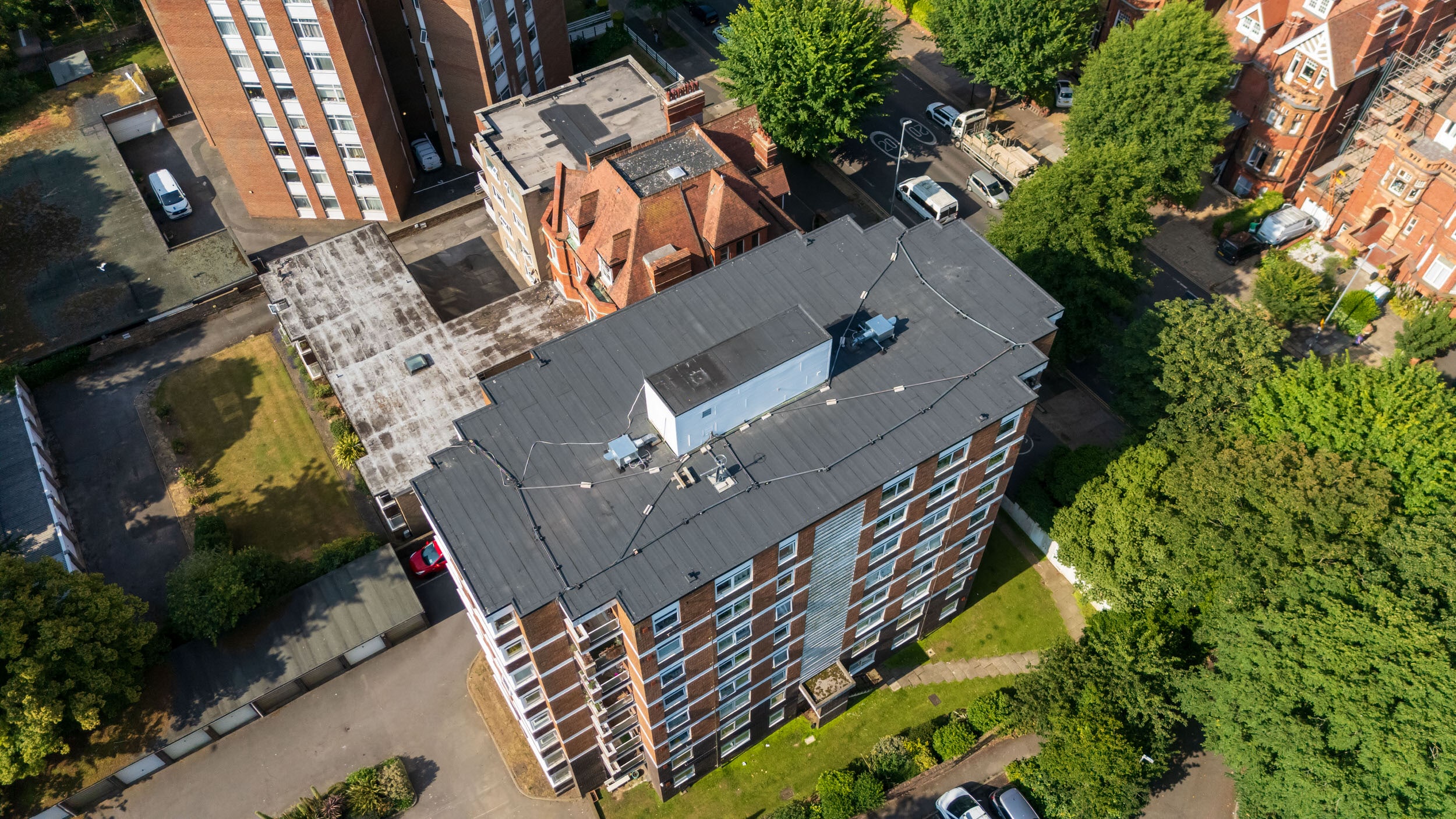
Hot melt is a monolithic waterproofing system, laid hot so that it bonds completely to the deck with no seams or laps to fail. It earns its place where a leak would be expensive and disruptive to trace, and where the waterproofing sits beneath something else: a podium deck, a roof terrace, a car park or the build up of a green roof. Because the membrane bonds fully to the substrate, water cannot track between layers, so a defect stays where it happened rather than surfacing somewhere else entirely.
In Southampton that suits the larger flat areas on blocks and commercial buildings, and any roof carrying a deck or terrace above the waterproofing. It is one of our own core systems rather than something we subcontract, and we survey the deck and the existing build up before specifying it.
Or speak with our friendly team:
Because so much of the city was rebuilt at once, Southampton carries an unusual amount of flat and shallow pitched roofing: post war blocks, maisonettes, garage runs, and the extensions added to almost everything since. Those roofs are now well into or past their intended lives, and they fail differently from pitched roofs. Water sits rather than runs, so the falls and the outlets matter more than the covering, and the failure usually starts at an edge or an upstand rather than out in the open.
Or speak with our friendly team:


Nationwide Roofing Southern has been roofing across the South East for over 50 years. We are members of the National Federation of Roofing Contractors and we are CHAS accredited, with full public liability and employer’s liability insurance in place on every job and a certificate available on request. Our system warranties cover labour, materials and damage. Surveys and quotes are free, come in writing, and carry no obligation.
Or speak with our friendly team:
If a Southampton roof is leaking, holding water, or simply old enough to be worth a proper look, the survey costs nothing. We look at the roof and the loft where there is one rather than judging it from the pavement, and put in writing what we found, what we would do and what it includes.
Or speak with our friendly team:
Southampton sits at the head of Southampton Water, partly sheltered by the Isle of Wight but still exposed to salt-laden air and the heavy south-westerly gales that come up the Solent. Salt accelerates corrosion on metal flashing, fixings and untreated lead, particularly on properties closest to the docks and waterfront. Urban density and pollution mean moss and algae thrive on shaded north-facing slopes. Frost damage to cracked pointing on older Victorian and Edwardian terraces is also common in winter. We specify marine-grade fixings on waterfront properties.
Yes. Southampton has more than 15 conservation areas, including the Old Town, Bedford Place, Polygon, Highfield and several historic streets, with listed buildings throughout including parts of the medieval walls. Some have Article 4 Directions or listed building protections that can restrict roof shape, slope, tile material and rooflight placement. Planning consent and listed building consent are the homeowner’s responsibility. We recommend checking with Southampton City Council’s planning team before any roof work begins, and we will work to whatever specification the council approves.
Southampton’s housing stock includes Victorian and Edwardian terraces across central districts with natural-slate or clay-tile pitched roofs, post-war reconstructions following Second World War bombing, large stocks of inter-war and post-war suburban housing, plus modern apartment blocks around the waterfront. Pitched roofs typically use clay tile or natural slate, with concrete interlocking tiles on newer developments. Flat roofs are usually hot melt or EPDM. Each comes with a different maintenance pattern.
After a strong south-westerly up the Solent, look for slipped, cracked or missing slates and tiles, dislodged ridge or hip tiles, debris in valley gutters and parapet boxes, and damp patches on top-floor ceilings or chimney breasts. Salt-corroded fixings on older lead flashing are a particular vulnerability on Southampton waterfront properties. If you spot anything, get it covered or assessed before the next weather front arrives.
Bomb damage and what replaced it. Southampton lost a great deal of housing during the war and much of it was rebuilt in place, so a Victorian or Edwardian terrace frequently sits directly beside post war infill. Two properties a few metres apart can have entirely different roofs: steep natural slate on one, a shallow pitch or a flat roof on the other. It means a neighbour’s quote is often not a guide to yours, because it may not have been the same job.
Yes, and it cuts both ways. Southampton Water gives shelter from the worst of the open Channel weather, so roofs here are not taking the same battering as somewhere fully exposed. What you do still get is salt in the air, which corrodes fixings and flashings regardless of how sheltered the site feels, and wind funnelled along the water rather than arriving off open sea. The practical upshot is that the covering often outlasts the things holding it down.
It happens more than people realise on terraces, because water does not respect a boundary. It gets in at a shared valley, a party wall abutment or a failed flashing on the neighbouring side, then tracks along the timbers and appears in your property. The first thing to establish is where it is actually entering, which is what the survey is for. Knowing that turns an argument into a straightforward conversation, because you are then discussing a specific defect in a specific place rather than whose fault it might be.
Usually it means the repair addressed the symptom rather than the entry point, which is the most common reason a leak comes back. Water can travel a long way along a rafter before it shows, so a repair made directly above the stain often misses the actual defect entirely. It can also mean a second, separate problem that was always there and only became obvious once the first was fixed. Either way it needs tracing properly rather than patching again in the same place.
It is one of the more useful things you can do, and it is rarely covered properly by a standard survey, which often notes a roof as needing further investigation and leaves it there. A roof is one of the more expensive things on a property to put right, so knowing whether you are looking at a repair or a full replacement changes what the house is worth to you. We are glad to look at a roof for a buyer and set out in writing what we found, and the survey costs nothing.
Yes, and we would say so even though it means being compared. What matters is comparing like with like: whether the quote includes stripping back or covering over, what happens to battens and underlay, whether the price covers scaffolding, and what guarantee sits behind it. A cheaper number usually means a smaller job rather than a better deal, and the difference is normally in the parts nobody can see once the work is finished. Ask each quote to spell that out in writing.
Or speak with our friendly team:
Or speak with our friendly team:
At Nationwide Roofing Southern, we are members of the National Federation of Roofing Contractors (NFRC) and we are CHAS accredited. Our accreditations reflect our commitment to high-quality service, strict safety standards, and lasting results. Whether it’s repairs, installations, or maintenance, you can trust our skilled team to deliver reliable roofing solutions that meet industry expectations.

Cookies on this site
Essential cookies keep this site working. Everything else is optional and stays switched off until you choose.
Privacy settings
Choose which optional cookies this site may use. Each purpose below says what it does and which companies it involves.