
Nationwide Roofing Southern delivers reliable, high-quality roofing services across Crowborough. With over 50 years of experience, we provide tailored roofing solutions with free surveys and quotes.
Or speak with our friendly team:
Crowborough sits higher than anywhere else in the Weald, up on the ridge beside Ashdown Forest, and height changes the weather in ways that show up on a roof. It is colder here than the towns a few miles below, wind arrives with less to slow it, and when snow does come it lies longer and blows about rather than settling politely. Roofs at this elevation get a harder and longer winter than the rest of Sussex, and the details that cope with rain do not always cope with what happens up here.
Or speak with our friendly team:

We prioritise timely project completion with minimal disruption to your home or business, ensuring you receive dependable roofing solutions when you need them.
Our fully accredited and qualified team adheres to the highest industry standards, ensuring safe, professional roofing installations and repairs.
We use premium materials to create long-lasting, weather-resistant roofs that protect your property for years.

We keep every system in house rather than fitting the one we happen to specialise in, so the advice is about your roof and not about our kit:
Or speak with our friendly team:
A new roof starts underneath the covering. We strip back, check the battens, underlay and rafters, and put right whatever the old roof was hiding before anything new goes on. At this elevation the underlay is not a formality, because it is the layer that deals with anything driven past the tiles, and that matters more here than lower down. Everything is laid to the manufacturer’s specification so the warranty stands behind it.
Roofs get replaced when the covering has aged out rather than after one failure. Up here the tell is often what happens in winter rather than what the roof looks like in summer: damp appearing in cold weather, ice forming at the eaves, snow finding its way in. A re-roof is the moment to renew the underlay, sort the eaves detail and deal with insulation and ventilation together, since all three are involved in what goes wrong in the cold.
You can see that in practice on a full roof replacement in Crowborough, which was stripped back to the rafters before upgraded coverings and ventilation went on.
We trace a leak to where the water is getting in rather than to where it shows on the ceiling. In Crowborough a good share of what we are called to appears during or just after freezing weather: meltwater backing up under tiles, snow driven through a gap that rain would have run past, or a valley blocked with forest leaf litter and then frozen solid. Those need diagnosing rather than patching, because the entry point is rarely where the stain is.
Flat roofs around Crowborough sit on extensions, garages, porches and dormers. We install and repair felt, single ply, EPDM and GRP fibreglass systems, set the falls so water reaches the outlets rather than standing, and detail the upstands properly. Standing water matters more at this height than most places, because water that sits will freeze, and ice does considerably more damage to a covering and its joints than rain ever will.
Clay tile and slate on the Victorian and Edwardian villas, concrete interlocking across the later housing. We match size, profile and colour as closely as we can source when new material is needed, and weathered material never matches new exactly, so we say so before you commit. On an exposed ridge top site the fixing specification is set for the wind rather than for the minimum, because a nominally fixed roof and a properly fixed one look identical until it blows.
A green roof needs a deck that will carry the loading, the right falls, and a waterproofing layer designed to sit beneath a growing medium. At this elevation the loading calculation has to allow for snow sitting on top of the build up as well as for the build up itself, and the edges need detailing so wind cannot get at them. Around Crowborough the practical candidates are flat areas on extensions, garages and outbuildings. We survey before specifying anything.
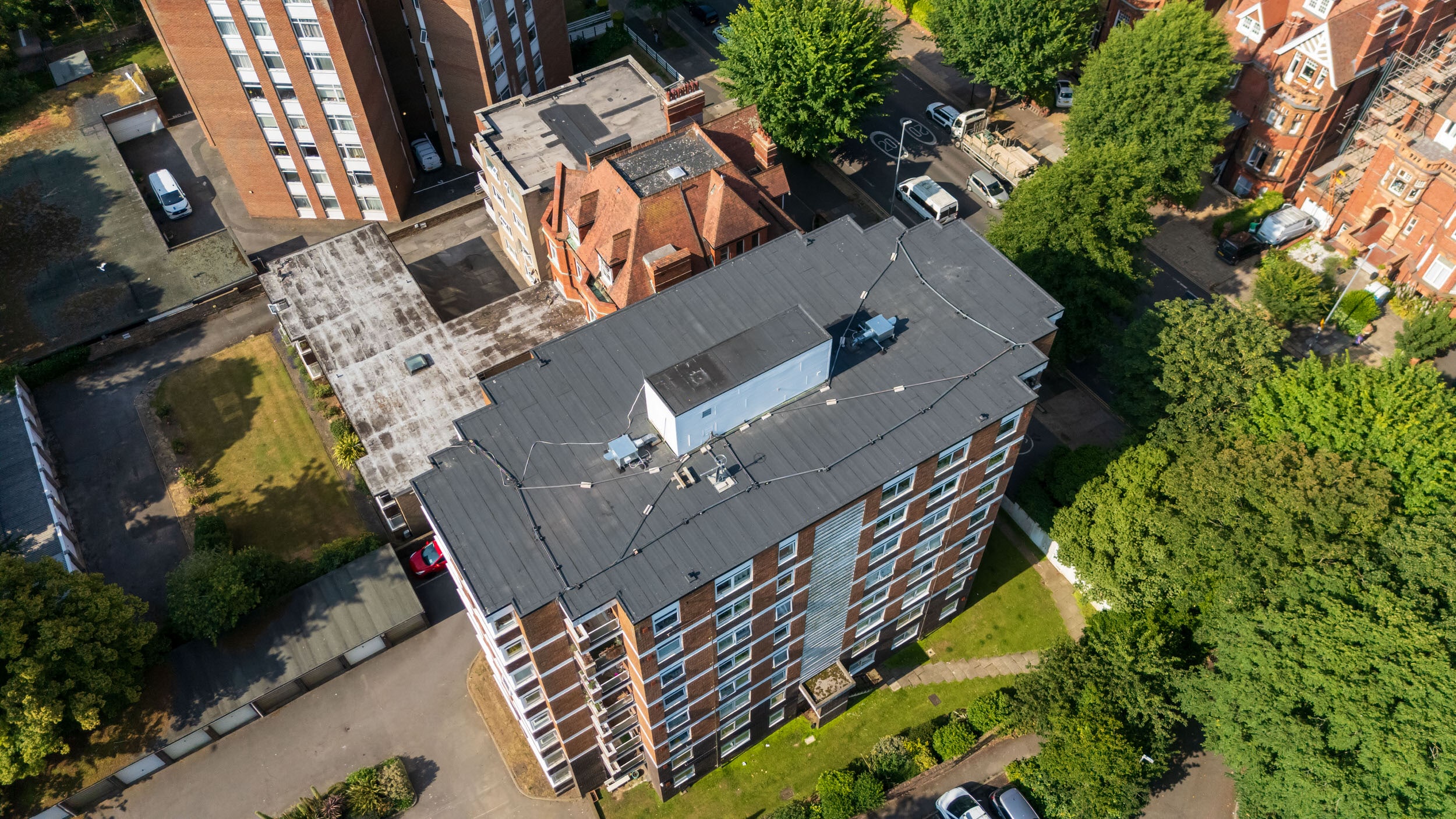
Hot melt is a monolithic waterproofing system, laid hot so that it bonds completely to the deck with no seams or laps to fail. It earns its place where a leak would be expensive and disruptive to trace, and where the waterproofing sits beneath something else: a podium deck, a roof terrace, a car park or the build up of a green roof. Because the membrane bonds fully to the substrate, water cannot track between layers, so a defect stays where it happened rather than surfacing somewhere else entirely.
Having no laps also matters where freeze and thaw work on a roof all winter, since there is nothing for ice to prise apart. Around Crowborough it is most relevant on larger flat areas and on roofs carrying something above the waterproofing.
Or speak with our friendly team:
Crowborough grew as a Victorian and Edwardian resort, promoted for its high, dry air, so its older stock runs to substantial villas with steep pitches, gables and dormers. Around and beyond them sit twentieth century housing and modern estates, with Ashdown Forest and heavy tree cover on the doorstep. Complicated roofs and a lot of leaf fall are a poor combination, because the valleys and junctions that make those villas handsome are exactly the places debris collects and snow sits.
Or speak with our friendly team:


Nationwide Roofing Southern has been roofing across the South East for over 50 years. We are members of the National Federation of Roofing Contractors and we are CHAS accredited, with full public liability and employer’s liability insurance in place on every job and a certificate available on request. Our system warranties cover labour, materials and damage. Surveys and quotes are free, come in writing, and carry no obligation.
Or speak with our friendly team:
If a Crowborough roof has stained a ceiling after a cold spell, or is old enough to be worth checking before the winter, the survey costs nothing. Damp that appears in freezing weather rather than in rain is worth taking seriously, because it usually points at something other than a hole. We put what we find in writing, with a price against it.
Or speak with our friendly team:
Crowborough sits at one of the highest points in the High Weald of East Sussex, on the edge of Ashdown Forest. The town’s elevated position means roofs see more wind and harder frost than lower-lying parts of the Weald. Westerly and south-westerly autumn gales test ridge tiles, slate clips and chimney pointing on exposed hilltop and ridge-line properties. Heavy tree cover from the surrounding forest means autumn leaf fall and storm-fallen branches are real risks. Salt-related corrosion is not a factor this far inland.
Yes. Crowborough has a designated conservation area covering the historic core around the Beacon, with listed buildings throughout the older parts of the town, and sits within the High Weald National Landscape. Conservation area rules and listed building consent are the homeowner’s responsibility and can restrict roof shape, slope, tile material and rooflight placement. We recommend checking with Wealden District Council’s planning team before any roof work begins, and we will work to whatever specification the council approves.
Crowborough has a strong stock of large Victorian and Edwardian villas with natural-slate pitched roofs, often with decorative finials and bargeboards. Inter-war detached and semi-detached housing across the town typically uses clay tile pitched roofs. Newer estates use concrete interlocking tiles, with hot melt or EPDM on flat extensions, garages and dormers. Many older Wealden cottages on the parish edges carry heavy clay peg tiles that need careful matching when replaced. Each comes with a different maintenance pattern.
After a strong westerly or south-westerly across the High Weald, look for slipped, cracked or missing slates and tiles, dislodged ridge or hip tiles, fallen branches across roof slopes, leaf-fall and debris blocking valleys and gutters, and damp patches on top-floor ceilings or chimney breasts. Storm-fallen tree limbs are a particular risk in Crowborough given the elevated position and Ashdown Forest surroundings. If you spot anything, get it covered or assessed before the next weather front arrives.
For roofing purposes, yes. Crowborough sits higher than anywhere else in the Weald, and height is the whole difference. It is colder up on the ridge than in the valleys below, wind reaches it with less in the way, and when snow arrives it tends to lie longer and get blown about rather than settling and quietly melting. None of that is dramatic on any single day. Over a winter it means roofs here are asked to do more than the same roofs a few miles downhill.
Because it does not need gravity. Rain falls and runs down the outside of the tiles. Wind driven snow is fine, dry and airborne, so it goes wherever moving air goes, including sideways and upwards through the small gaps between tiles that rain would simply run past. It then sits on the underlay, or on the loft insulation if there are gaps, and melts when the roof space warms. People find damp insulation and staining on the timbers and go looking for a hole, when what happened is that snow got in where water never could.
Rarely on a normal pitched roof in this country, which is designed with a sensible margin. Where weight does matter is on flat and shallow roofs, on older or altered structures where timbers have already been weakened, and where snow slides and piles up somewhere it was not meant to, such as onto a lower extension roof from a larger one above. A snowfall that clears in a day is not the issue. Snow that lies and then absorbs rain gets considerably heavier than it looks.
You get ice building up at the coldest part of the roof, and that is a genuine problem rather than a curiosity. Warmth escaping into the roof space melts snow higher up, the meltwater runs down to the eaves where there is no warmth beneath it, and it refreezes. The ice builds and dams the route water should be taking, so the next lot of meltwater has nowhere to go except sideways and back up under the tiles. It is one of the reasons damp appears during a thaw rather than during rain.
The eaves is the bottom edge of the roof, where the covering, the underlay, the ventilation path and the roof structure all have to work together and hand the water off cleanly. It is a small area doing several jobs at once. Get it right and everything that lands on the roof leaves it; get it wrong and it is where water backs up, where ice forms, and where rot starts in the timbers because it stays wet longest. On a cold exposed roof it is worth more attention than anywhere else on the building.
Both have a point, and after is the one people skip. Before winter you are checking that everything is sound and clear. After a hard one you are finding out what the winter actually did: fixings worked loose, mortar cracked by frost, a valley that has been holding ice, underlay torn where snow got in and froze. Those things do not repair themselves over the summer, and dealing with them in spring is a great deal cheaper and easier to schedule than dealing with them in February.
Or speak with our friendly team:
Or speak with our friendly team:
At Nationwide Roofing Southern, we are members of the National Federation of Roofing Contractors (NFRC) and we are CHAS accredited. Our accreditations reflect our commitment to high-quality service, strict safety standards, and lasting results. Whether it’s repairs, installations, or maintenance, you can trust our skilled team to deliver reliable roofing solutions that meet industry expectations.

Cookies on this site
Essential cookies keep this site working. Everything else is optional and stays switched off until you choose.
Privacy settings
Choose which optional cookies this site may use. Each purpose below says what it does and which companies it involves.