
Nationwide Roofing Southern delivers reliable roofing services across Chislehurst. With over 50 years of experience, we provide high-quality roofing solutions, complete with free surveys and quotes.
Or speak with our friendly team:
Chislehurst is a suburb of large houses, and a large house has a large roof. That sounds obvious, and it has a consequence that catches people out: a big, complicated roof rarely fails all at once. It fails in one place, gets patched, holds for a while, then fails somewhere else. Do that for thirty or forty years and what you have is not really one roof any more. It is a covering with a long history of separate repairs, often in different materials, done by different people to different standards, and usually nobody has a record of any of it. That matters when the next leak appears, because the honest answer to what is wrong is frequently that it depends on what was done last time. Most of what we are asked to look at in Chislehurst is a roof in exactly that condition, and the first job is establishing what is actually up there before anyone prices the next repair.
Or speak with our friendly team:

We prioritise timely project completion with minimal disruption to your home or business, ensuring you receive dependable roofing solutions when you need them.
Our fully accredited and qualified team adheres to the highest industry standards, ensuring safe, professional roofing installations and repairs.
We use premium materials to create long-lasting, weather-resistant roofs that protect your property for years.

Nationwide Roofing Southern has been roofing across the South East for over 50 years. We are members of the National Federation of Roofing Contractors and we are CHAS accredited, with full public liability and employer’s liability insurance in place on every job and a certificate available on request. Our system warranties cover labour, materials and damage. On a roof with an unknown repair history that matters more than usual, because the work has to be specified on what is found rather than on what was assumed, and you want the specification and the guarantee in writing before anyone starts.
Or speak with our friendly team:
A new roof on a Chislehurst house is usually a large one, so the detailing matters as much as the covering. We set out the structure, the ventilation, the insulation and every junction before anything is ordered, and we match the covering to the property rather than to whatever is quickest to lay. New build, extension or full replacement, the specification is written down before work starts.
Re-roofing is the right call when the repairs have stopped holding, which on a much patched roof is a judgement rather than a date. Stripping back shows what the previous work was hiding: tired battens, failed underlay, corroded fixings, mortar that has given up. We replace what needs replacing rather than covering it, and you see the roof in its stripped state before it is closed up.
Most Chislehurst calls start as a repair, and on a complex roof the first job is finding where the water actually gets in. A stain on a bedroom ceiling can begin several metres away at a valley or a chimney tray. We trace it properly instead of sealing the nearest suspect, because a repair aimed at the wrong place is the reason so many roofs here have been patched over and over.
Flat roofs here are mostly extensions, garages, dormer tops and the small linking sections between one part of a big house and another. Those linking areas are the ones people forget, and they are frequently the source of a leak blamed on the pitched roof above. We survey them as part of the whole covering and specify a warm or cold build up on what the deck and the detail will actually take.
Chislehurst’s older property is clay tile and natural slate, and the newer stock is concrete interlocking. Matching matters on a partial job, and so does what sits under the covering: underlay, battens and fixings do the work that keeps a tile where it was put. We re-fix and re-lay rather than replacing sound material for the sake of it.
A green roof needs a deck that will carry the loading, the correct falls and a waterproofing layer designed to live under a growing medium. On Chislehurst property the realistic candidates are garages, outbuildings and flat roofed extensions rather than the main house. We survey the structure before specifying anything, and we say plainly if the deck will not take it.
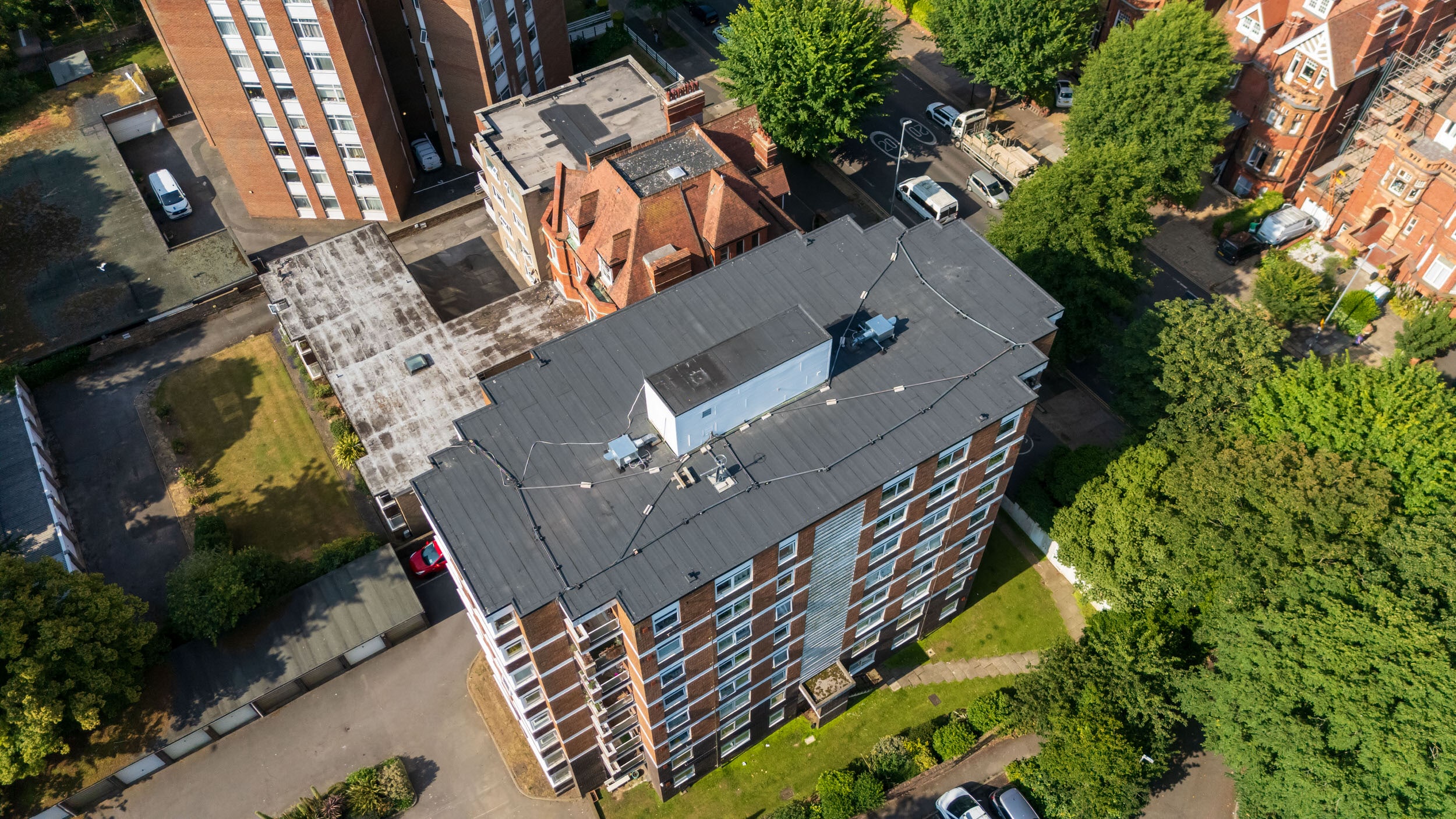
Hot melt is a monolithic waterproofing system, poured hot and bonded to the deck with no seams to fail, which is why it is used on roofs that carry something above them: terraces, balconies, podium decks and green roof build ups. On a large Chislehurst property that usually means a flat terrace over habitable space, where a leak is expensive and getting back to it later is not simple. It is a specialist system and we install it ourselves.
Or speak with our friendly team:
The housing runs from Victorian and Edwardian villas through substantial interwar detached and semi detached property to later infill, and most of it sits on generous plots rather than in continuous terraces. That shapes the roofs. They are big, and they are cut up by hips, valleys, bay roofs, dormers and more than one chimney, and almost every one of those features is a junction where two surfaces meet. Junctions are where roofs leak. A long straight run of tile or slate is comparatively easy to keep watertight; it is the flashing, the valley, the abutment and the chimney tray that go first, and a house with six of them has six times the exposure. It also means no two roofs on the same road are quite the same job, so a neighbour’s price is a poor guide to yours.
Or speak with our friendly team:


Every system below is one we install and maintain ourselves, so on a roof with several different problems at once nobody has to hand you off, and the recommendation is not shaped by the one product we happen to fit:
Or speak with our friendly team:
If a Chislehurst roof has been patched more times than anyone can remember, or is leaking again in a place that was supposedly fixed, the survey costs nothing. On this kind of roof that means going over the whole covering and into the loft rather than looking at the spot where the water shows, because on a big roof the entry point and the stain are often nowhere near each other. We put what we find in writing, with what we would do and what it includes. Ask us for a free, no obligation quote.
Or speak with our friendly team:
Chislehurst sits in south-east outer London, at the upper edge of the Cray Valley with extensive heath and woodland around the common. Roofs here see a mix of urban and woodland pressures. Air pollution and damp shaded sites accelerate moss and lichen growth on north-facing slopes, and the heavy tree cover around Chislehurst Common means autumn leaf fall and storm-fallen branches are real risks. Frost damage to cracked pointing on older Victorian villas and Edwardian semis is the main winter issue. Salt-related corrosion is not a factor in Chislehurst.
Yes. Chislehurst has a designated conservation area covering much of the older village around the common, with listed buildings throughout. Some streets carry Article 4 Directions that can restrict roof shape, slope, tile material and rooflight placement. Planning consent and listed building consent are the homeowner’s responsibility. We recommend checking with the London Borough of Bromley’s planning team before any roof work begins, and we will work to whatever specification the council approves.
Chislehurst has a strong stock of large Victorian and Edwardian villas with natural-slate or clay-tile pitched roofs, often with lead-lined valley gutters and decorative finial work. Inter-war semis and detached housing run clay tile pitched roofs. Newer estate housing and modern apartment blocks use concrete interlocking tiles, with hot melt or EPDM on flat extensions and garages. Each comes with a different maintenance pattern.
After a strong westerly or south-westerly blow, look for slipped, cracked or missing slates and tiles, dislodged ridge or hip tiles, fallen branches across roof slopes, leaf-fall and debris in valley gutters, and damp patches on top-floor ceilings or chimney breasts. Storm-fallen tree limbs are a particular risk in Chislehurst given the surrounding common woodland. If you spot anything, get it covered or assessed before the next weather front arrives.
Sometimes, but not on the evidence of the leak alone. A repair is worth doing when the covering around it is sound and the fault is local, such as a slipped tile or a failed flashing. It is not worth doing when the same area has been patched repeatedly, because that pattern usually means the problem is the detail underneath rather than the surface. The way to tell is to look at the whole roof and the loft, not the wet patch. We will tell you which of the two you have, and why.
By working back from where the water shows rather than starting there. On a large roof water can enter at a valley, a chimney tray or an abutment and run along a batten or a rafter for several metres before it drops. We look at the covering from outside and at the underside from inside the loft, where the staining, the daylight and the run marks usually tell you far more than the ceiling does. Only then is it worth talking about what to fix.
Because they are junctions, and a junction has to be made watertight by a detail rather than by the covering itself. A run of tile or slate sheds water by its shape. A valley, a chimney tray, an abutment or a bay roof relies on lead, mortar or a formed detail, all of which have a shorter working life than the tiles around them. On a house with several chimneys and several valleys that is simply more places that can fail, and they tend to fail first.
It can be, and it is sometimes a sensible way to spread a large job, but it needs planning rather than drifting into it. Doing one elevation now and another later means two sets of access, two mobilisations, and a join between old and new work that has to be detailed properly. It also means the second half carries on ageing while you wait. We will set out what a phased approach would involve alongside doing it in one go, so the comparison is a real one.
Going over the whole covering, not just the reported problem. On a large detached roof that means every elevation, the hips and valleys, the chimneys and their flashings, the bay and dormer roofs, the flat sections between wings, and the gutters and outlets. Then the loft, because the underside shows what the outside cannot. You get a written account of what was found, what we would do about it, in what order, and what the price includes. It costs nothing and there is no obligation.
On most Chislehurst roofs, yes. A large pitched roof cannot be worked safely or properly off ladders, and anything involving stripping, chimneys or valleys needs a working platform. Access is a genuine part of what a roof costs, and on a detached house it depends on the height, how many elevations are involved and how easily a scaffold can be built on the ground around the property. It is set out in the quote rather than added afterwards, and we tell you what it covers.
Or speak with our friendly team:
Or speak with our friendly team:
At Nationwide Roofing Southern, we are members of the National Federation of Roofing Contractors (NFRC) and we are CHAS accredited. Our accreditations reflect our commitment to high-quality service, strict safety standards, and lasting results. Whether it’s repairs, installations, or maintenance, you can trust our skilled team to deliver reliable roofing solutions that meet industry expectations.

Cookies on this site
Essential cookies keep this site working. Everything else is optional and stays switched off until you choose.
Privacy settings
Choose which optional cookies this site may use. Each purpose below says what it does and which companies it involves.