
Nationwide Roofing Southern provides reliable roofing services across Elstead. With over 50 years of experience, we deliver high-quality roofing solutions backed by free surveys and quotes.
Or speak with our friendly team:
Roofing in Elstead means working on two quite different settings a few hundred yards apart. Down by the river and the green is the old village: timber framed and brick cottages, a few in the local sandstone, under clay peg and plain tiles, with the Victorian rebuilds in tile or slate among them and a conservation area over the lot. Up the lanes towards the commons the houses are newer and larger, set among Scots pine and birch on sandy ground, with concrete tile roofs, extensions, garages and the flat roofs that go with them. We repair, re-roof and build new roofs on both, from a single slipped tile on a cottage to a full strip and re-cover on a heath edge house, and we install flat roofing, hot melt and green roof systems where the property calls for them.
Every Elstead job starts the same way, with a free survey and a written quote that sets out what we found and what we propose. On a village where the roofs range from three hundred years old to thirty, that first look is where the real decisions get made.
Or speak with our friendly team:

We prioritise timely project completion with minimal disruption to your home or business, ensuring you receive dependable roofing solutions when you need them.
Our fully accredited and qualified team adheres to the highest industry standards, ensuring safe, professional roofing installations and repairs.
We use premium materials to create long-lasting, weather-resistant roofs that protect your property for years.

Nationwide Roofing Southern has been roofing for over 50 years. We are members of the National Federation of Roofing Contractors and we are CHAS accredited. Every Elstead job carries full public liability and employer’s liability insurance, with certificates available on request, and our roofing systems come with a written warranty covering labour, materials and damage. Elstead sits in the western part of the Surrey area we cover, between Farnham and Godalming, and we survey and quote there as we do everywhere else: free, in person and in writing.
Or speak with our friendly team:
New roofs in Elstead are most often over rear and side extensions on the heath edge houses and garage rebuilds, with the occasional new build on a plot in the village. We design and install the complete system, structure, underlay, covering and leadwork, and on a site under pines we size the outlets and detail the valleys for needle fall from the start rather than finding out the hard way.
When an Elstead roof is past repairing we strip it back, deal with any timber that needs it, and re-cover with underlay, new battens and clay tile or slate matched to the house. On the old cottages the new roof follows the settled line of the existing timbers and keeps the character of the original. Ridges and verges go on as dry fixed systems where the building allows.
Slipped and broken tiles, loose ridge tiles, lifted lead at chimneys and abutments, needle choked valleys and the odd branch through the tiles make up most of the repair work we do in Elstead, and the westerlies across the open commons produce most of it. We find what is actually letting the water in, note what has collected on the roof while we are there, and price the repair against what is genuinely needed.
Extensions, garages, dormers and porches in Elstead nearly all carry a flat roof, and under pines those roofs are on the front line. We install and replace flat roofs in EPDM, GRP, single ply and hot melt systems, matched to the size of the roof and what drains onto it, and we get the falls and outlets right, and generous, so needle fall does not turn the roof into a pond.
Elstead’s older roofs are clay, much of it peg tile, with slate on some of the Victorian rebuilds and clay or concrete tile on everything since. We repair and replace all of them, match hand made and machine made clay so a repaired slope does not stand out from the lane, and re-detail the ridges, verges and flashings that give old tiled roofs most of their trouble.
On the heath side of Elstead a green roof does two jobs: it takes the sun off the waterproofing beneath it and it puts a flat extension or garage roof back into the landscape instead of leaving a felt deck under the pines. We build green roof systems on a waterproof layer specified for the purpose, check that the structure will carry the growing medium wet, and size the drainage layer and outlets for needle fall.
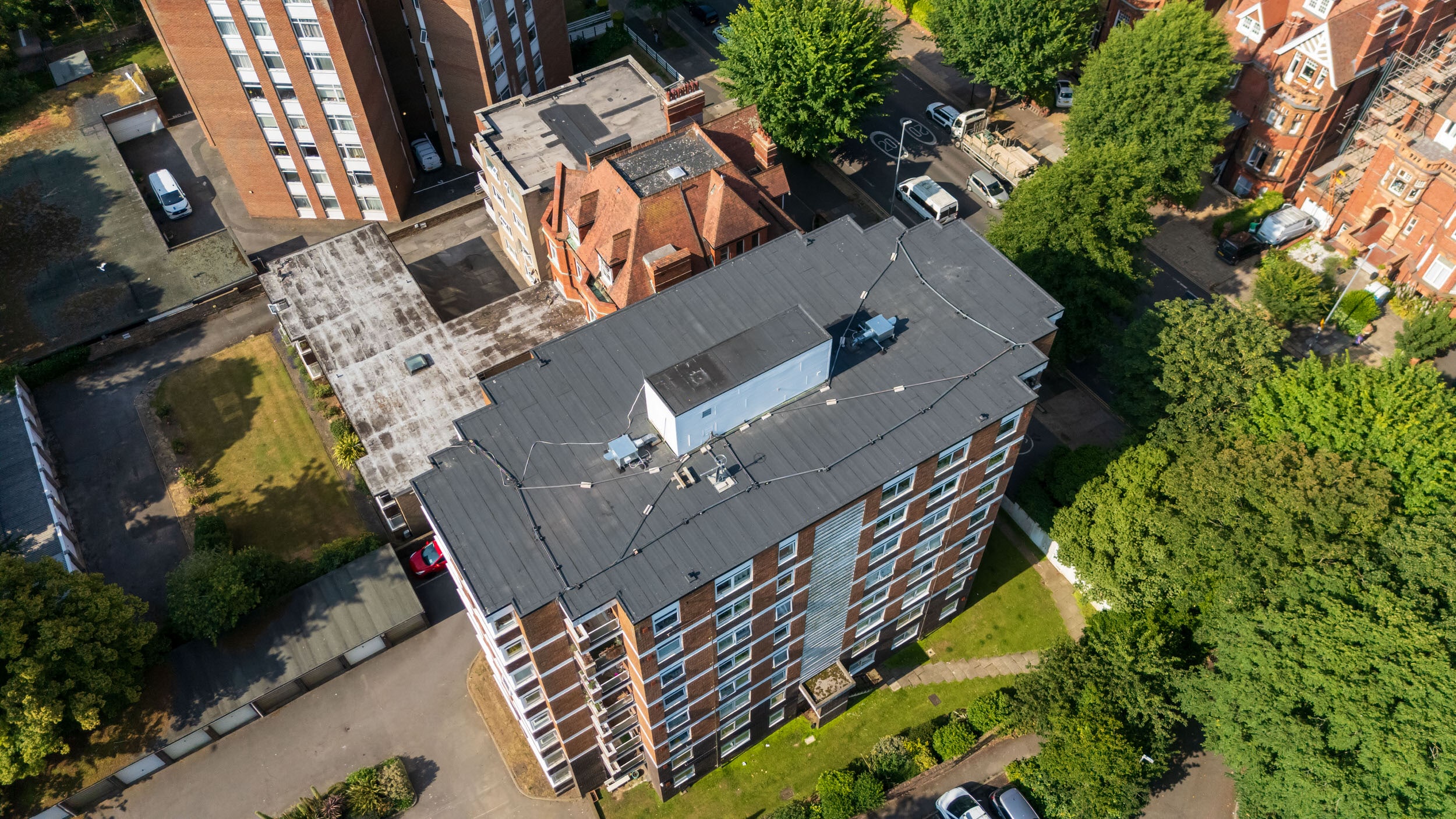
Hot melt is applied as a liquid and reinforced as it sets, so the finished waterproofing has no laps or joints at all, which under pine trees is worth a great deal: there is nowhere for a needle to lodge and nowhere for water to track. Around Elstead we specify it for larger flat roofs, podium decks and any roof that will be covered over by a terrace or a green roof and cannot be inspected again.
Or speak with our friendly team:
Every roofer talks about leaves in the gutters. Around Elstead the problem is pine needles, and they behave differently. Leaves fall in a few weeks in autumn, sit loose and mostly wash through. Needles fall all year, they are thin enough to pass through mesh and slip under tiles, and once wet they mat together into a dense, acidic felt that holds water against whatever it is lying on and does not wash away. On a pitched roof that means blocked valleys and needle drifts behind chimneys and against dormer cheeks, where the covering stays wet for weeks. On a flat roof it means a mat over the outlet, so the roof ponds long before anyone notices, and needles under a lap or in a gutter joint that keep it permanently damp.
The sandy ground makes the other half of the picture. Elstead’s soil drains almost instantly, so there is little of the ground damp and moss that troubles roofs on clay elsewhere in Surrey; a roof here that is wet is wet because of what is lying on it, not because of where it stands. That is why, on every Elstead survey, we look at what has collected on the roof as carefully as at the roof itself, and why on flat roofs here we pay particular attention to outlet size and position.
Or speak with our friendly team:


The old village around the green and the bridge is roofed in clay, much of it in peg tiles hung on pegs rather than nibs, over timber that has moved a good deal in its lifetime. Those roofs need a roofer who can match a hand made tile, read a settled timber, and detail lead into brick and sandstone that was never square. The larger houses along the lanes towards Elstead, Hankley and Thursley commons date mostly from the twentieth century, under concrete or clay tile, and their roofs are more about the extensions, dormers and garages that have been added since, and about the pines standing over them. And the estate housing and infill of the last sixty years has the faults of its age: porous concrete tiles, felt flat roofs on their second patch, and leaks where an extension meets the main roof. We roof all three, and we tell you which of those you have and what it actually needs.
Or speak with our friendly team:
Whether the roof is a cottage by the green, a house under the pines or an extension on one of the newer roads, the survey is free and so is the written quote. Let us know which part of the village the property is in and what the roof has been doing, and we will come and look. Request your free Elstead roof survey.
Or speak with our friendly team:
Dry underfoot and exposed overhead. Elstead’s sandy ground drains almost as soon as rain has fallen, so the ground damp that feeds moss on roofs elsewhere in Surrey is largely absent here, and a roof on the heath side of the village gets more sun and more wind than one in the valley. The open commons to the south and west give a westerly gale a long clear run at ridge tiles and chimney pointing, and frost does its usual work on cracked mortar and old clay in winter. What Elstead adds that other villages do not is the pines: needle fall all year round into valleys, gutters and flat roof outlets, holding water exactly where a roof least wants it. Salt is not a factor this far inland.
Yes. Elstead has a designated conservation area covering the historic village core, with listed buildings throughout the older parish, and sits close to the Surrey Hills National Landscape. Conservation area rules and listed building consent are the homeowner’s responsibility and can restrict roof shape, slope, tile material and rooflight placement. We recommend checking with Waverley Borough Council’s planning team before any roof work begins, and we will work to whatever specification the council approves.
Elstead’s older housing is Surrey heath vernacular: timber-framed and tile-hung cottages with clay-tile or peg-tile pitched roofs, plus brick farmhouses. Victorian and Edwardian additions typically run clay tile or natural slate. Newer estate housing and modern infill around the village edges use concrete interlocking tiles, with hot melt or EPDM on flat extensions and garages. Each comes with a different maintenance pattern.
Look first for what has landed on the roof, because around Elstead a westerly brings down branches and a fresh load of needles before it does anything else. Check the slopes for slipped, cracked or missing tiles and for branches lying across them, the ridge and hips for tiles that have moved, the lead around the chimneys, and the valleys and gutters for needle drifts and debris, particularly where a valley or a flat roof outlet was already holding some. Inside, check the top floor ceilings and the loft. If a branch has come through, or a valley is blocked and overflowing, have it covered or cleared before the next front rather than waiting to see whether it leaks.
Because of how they behave once they are down. Leaves fall over a few weeks, sit loose and mostly wash through a valley or a gutter. Needles fall all year, they are thin enough to pass through mesh guards and to work under tiles and laps, and when wet they mat into a dense, slightly acidic felt that holds water against the covering and does not move again. On a pitched roof that keeps a valley or the ground behind a chimney wet for weeks at a time. On a flat roof the mat forms over the outlet, so the roof starts to pond before anyone notices, and standing water is what shortens a flat roof’s life. Clearing them is a maintenance job; designing the roof so a needle mat cannot stop it draining is ours.
Yes. Surrey is part of the area we cover, alongside Sussex, Kent and London, and Elstead sits in its western part between Farnham and Godalming. We survey and quote for roofing work in the village and the settlements around it, including Milford, Thursley, Tilford and Frensham. If you are not certain whether your address is one we cover, ask. It costs nothing to find out and the survey is free either way.
A little. A roof up on the heath edge gets more sun, more wind and more needle fall, so its wearing points are the ridges and verges that take the weather and the valleys and outlets that catch the needles, and a flat roof up there ages sooner in the sun. A roof down in the valley by the Wey is more sheltered and damper, with the mist off the river keeping north facing slopes and shaded corners wet, so moss and slow moving damp in the loft are more the pattern, and condensation is more often mistaken for a leak. Both are ordinary to look after; they just wear in different places, and the survey tells you which to keep an eye on.
Both, and the damage follows from the blocking. A needle mat over a flat roof outlet holds water across the roof, and standing water breaks down most coverings, freezes in winter and finds any weak lap or upstand. In a valley, a wet mat keeps the lining and the tiles either side of it saturated for weeks, which wears the lead, rots battens and lets frost get to work. Needles worked under a tile or a lap hold a permanent damp track into the roof. None of that happens overnight, but on an Elstead roof that has not been looked at for a few years it is usually what we find. Larger outlets, cleaner valley details and a covering with no laps for needles to enter are the answers when the roof is next worked on.
Yes. The cottages around the green and the bridge are the oldest roofs in Elstead, with clay peg and plain tiles over timbers that settled long ago and lead dressed into brick and sandstone that was never square. We repair and re-tile them with matching hand made or machine made clay, keep the settled line of the roof rather than forcing it straight, and detail the flashings to suit the walls they meet. Where a property is listed or inside the conservation area the consents are the owner’s to obtain, and we work to whatever specification is approved.
Yes, and it should be, because most flat roofs in Elstead sit under or beside pines. The main things are the falls, which need to be positive enough that water and needles move towards the outlet rather than sitting, the outlets themselves, which want to be larger and better placed than the minimum, and the covering, which should have as few laps and joints as possible for needles to lodge in. A seamless system such as hot melt or a single sheet of EPDM suits that better than a lapped felt. We specify all of that on the survey and set it out in the written quote, so the roof is built for where it is rather than repaired for it later.
Or speak with our friendly team:
Or speak with our friendly team:
At Nationwide Roofing Southern, we are members of the National Federation of Roofing Contractors (NFRC) and we are CHAS accredited. Our accreditations reflect our commitment to high-quality service, strict safety standards, and lasting results. Whether it’s repairs, installations, or maintenance, you can trust our skilled team to deliver reliable roofing solutions that meet industry expectations.

Cookies on this site
Essential cookies keep this site working. Everything else is optional and stays switched off until you choose.
Privacy settings
Choose which optional cookies this site may use. Each purpose below says what it does and which companies it involves.