
Nationwide Roofing Southern delivers professional roofing services across Odiham. With over 50 years of experience, we provide high-quality roofing solutions backed by free surveys and quotes.
Or speak with our friendly team:
Roofs on the Sussex coast are worn out by salt and wind. Odiham sits inland on the north Hampshire chalk, well away from either, and the thing that does the damage here is frost. Water gets into porous tile, into mortar and into hairline cracks, freezes, expands and pushes everything very slightly apart, then thaws and does it again. One cycle changes nothing. A few hundred winters worth of them is why mortar crumbles out of a ridge and why an old tile eventually starts shedding its face.
Or speak with our friendly team:

We prioritise timely project completion with minimal disruption to your home or business, ensuring you receive dependable roofing solutions when you need them.
Our fully accredited and qualified team adheres to the highest industry standards, ensuring safe, professional roofing installations and repairs.
We use premium materials to create long-lasting, weather-resistant roofs that protect your property for years.

We keep every system in house rather than fitting the one we happen to specialise in, so the advice is about your roof and not about our kit:
Or speak with our friendly team:
A new roof starts underneath the covering. We strip back, check the battens, underlay and rafters, and put right whatever the old roof was hiding before anything new goes on. On Odiham property that frequently means dealing with mortar work that frost has been steadily destroying for decades. Everything is laid to the manufacturer’s specification, or to whatever specification has been approved on a listed building, so the warranty stands behind it.
Roofs get replaced when the covering has aged out rather than after one failure. Inland that usually shows as frost damage accumulating: mortar gone from ridge and verge, tiles losing their surface, and water getting further in each winter than the last. A re-roof is also the moment to move ridges and verges onto mechanical fixings rather than mortar, which takes the frost problem out of the equation. We will tell you honestly when a roof still has years left in it.
We trace a leak to where the water is getting in rather than to where it shows on the ceiling. Around Odiham a great deal of what we are called to appears after a cold spell rather than after a storm, because frost opens up what was already marginal: a hairline crack in a tile, a soft patch of mortar, a lifted flashing. Small repairs done before winter cost far less than the same repair plus a ceiling in February.
Flat roofs around Odiham sit on extensions, garages, porches and dormers. We install and repair felt, single ply, EPDM and GRP fibreglass systems, set the falls so water reaches the outlets rather than standing, and detail the upstands properly. Standing water matters more inland than people think, because water that sits on a flat roof is water that will freeze on it, and ice does far more to a covering than rain ever does.
Clay tile through the old village property, concrete interlocking across the later estates. Where existing tiles are sound we salvage and re-lay them, and old handmade clay is often in better condition than people expect, because it copes with frost well. Where new is needed we match size, profile and colour as closely as we can source, and weathered material never matches new exactly, so we say so before you commit.
A green roof needs a deck that will carry the loading, the right falls, and a waterproofing layer designed to sit beneath a growing medium. Around Odiham the practical candidates are outbuildings, garages and modern extensions rather than listed fabric, and in a conservation area the appearance may be controlled, so consent comes first. We survey before specifying anything and will say plainly if a roof is not suited to one.
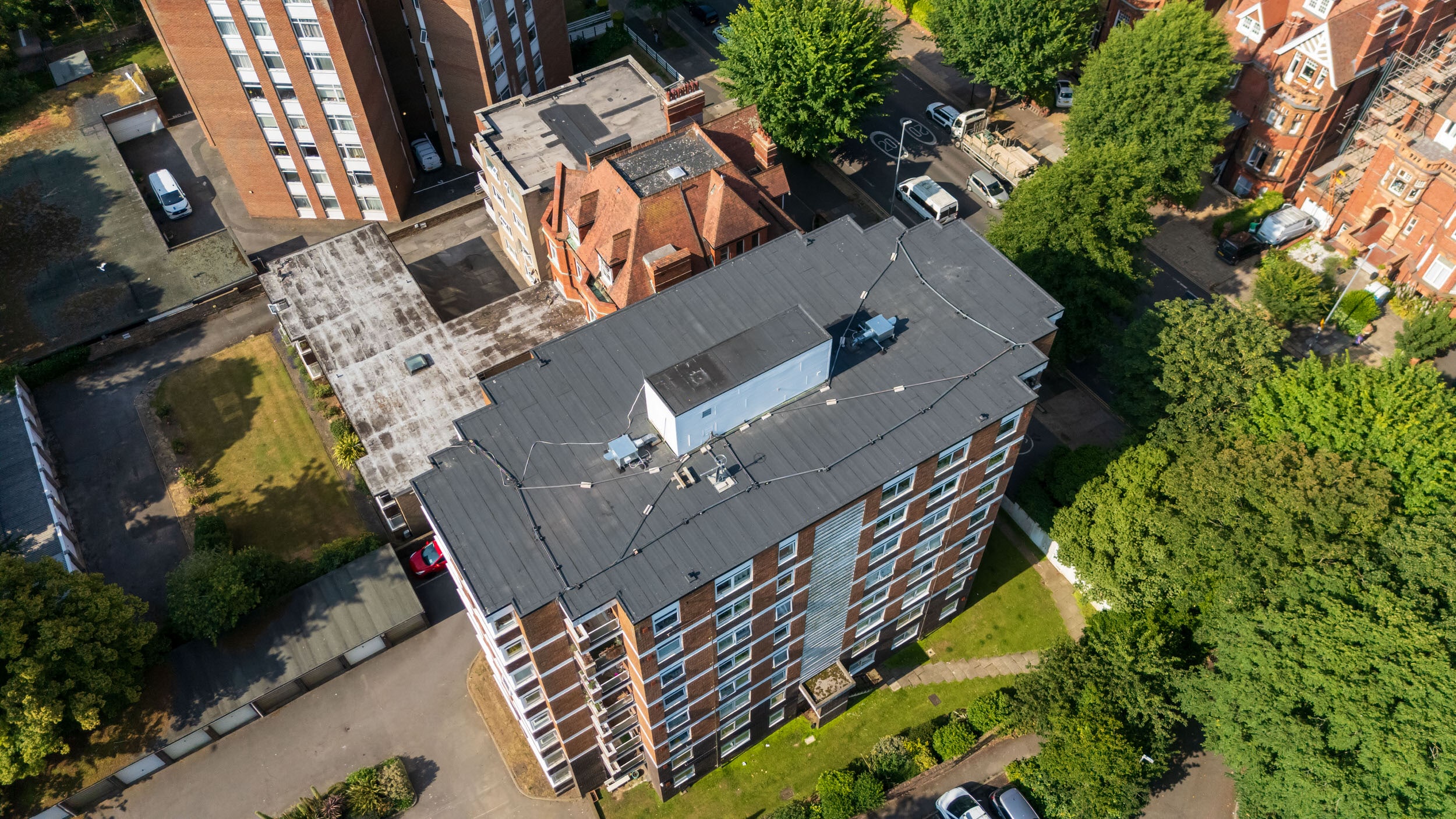
Hot melt is a monolithic waterproofing system, laid hot so that it bonds completely to the deck with no seams or laps to fail. It earns its place where a leak would be expensive and disruptive to trace, and where the waterproofing sits beneath something else: a podium deck, a roof terrace, a car park or the build up of a green roof. Because the membrane bonds fully to the substrate, water cannot track between layers, so a defect stays where it happened rather than surfacing somewhere else entirely.
Having no laps or seams also matters where freeze and thaw are working on a roof all winter, since a bonded membrane has nothing for ice to prise apart. Around Odiham it is most relevant on larger flat areas and on roofs carrying something above the waterproofing.
Or speak with our friendly team:
Odiham is brick and tile country rather than the timber frame and stone of the Weald. The old village centre is largely Georgian, much of it listed or in a conservation area, roofed in clay tile that has been on the building a very long time. Around it sit later Victorian housing and a good deal of modern estate development on concrete interlocking. Old clay handles frost far better than most things; old mortar does not, which is why the ridge lines usually go long before the tiles.
Or speak with our friendly team:


Nationwide Roofing Southern has been roofing across the South East for over 50 years. We are members of the National Federation of Roofing Contractors and we are CHAS accredited, with full public liability and employer’s liability insurance in place on every job and a certificate available on request. Our system warranties cover labour, materials and damage. Surveys and quotes are free, come in writing, and carry no obligation.
Or speak with our friendly team:
If an Odiham roof has crumbling ridge mortar, tiles that are starting to look flaky, or a leak that has appeared after a cold spell, the survey costs nothing. Frost damage is progressive rather than sudden, so it is one of the things genuinely worth catching early. We put what we find in writing, with a price against it.
Or speak with our friendly team:
Odiham sits on the chalk downland of north-east Hampshire, well inland from the coast. Roofs here are more exposed to wind and frost than salt. Westerly and south-westerly autumn gales test ridge tiles and chimney pointing on exposed properties, and the village’s elevated position means harder frost than the coast, which lifts cracked pointing and flashing over winter. Long humid spells in summer drive moss growth on shaded north-facing slopes. Salt-related corrosion is not a factor this far inland.
Yes. Odiham has a designated conservation area covering the historic village centre and surrounding streets, with listed buildings throughout the older village. Conservation area rules and listed building consent are the homeowner’s responsibility and can restrict roof shape, slope, tile material and rooflight placement. We recommend checking with Hart District Council’s planning team before any roof work begins, and we will work to whatever specification the council approves.
Odiham has a strong stock of Georgian and Victorian brick townhouses along the village centre with natural-slate or clay-tile pitched roofs, plus older timber-framed cottages in the surrounding streets. Inter-war and post-war housing on the village edges uses clay tile or concrete interlocking tiles. Modern developments around North Warnborough and the village fringe use concrete tile pitched roofs with hot melt or EPDM on flat extensions. Each comes with a different maintenance pattern.
After a strong westerly or south-westerly blow, look for slipped, cracked or missing slates and tiles, dislodged ridge or hip tiles, debris and leaf-fall in valley gutters, and damp patches on top-floor ceilings or chimney breasts. Lifted lead flashing around chimneys and tall Georgian parapets is common after Odiham gales. If you spot anything, get it covered or assessed before the next weather front arrives.
Because inland gets harder and more frequent frosts, and frost is a mechanical process rather than a chemical one. Water gets into porous tile, into mortar and into any hairline crack, then freezes and expands and pushes everything very slightly apart. It thaws, more water gets in, and it happens again. A single cycle changes nothing you could see. Repeated over enough winters it is what takes the mortar out of a ridge and the face off an old tile. On the coast salt does the damage instead; around Odiham it is frost.
Spalling is when the surface of a tile or a brick flakes away, and frost is usually the cause: water absorbed into the outer layer freezes and lifts it off. On a roof it shows as tiles that look pitted or scaled, often worse on the elevation that stays cold longest. A spalled tile has lost the dense outer surface that was keeping water out, so it soaks up more and spalls faster. It cannot be repaired, only replaced, but a roof with some spalled tiles is not necessarily a roof that needs replacing.
Yes, and more than the water it came from. Ice takes up more room than the water it froze from, so anywhere water sits is somewhere ice will lever things apart: laps, seams, upstands and the joints in a valley lining. It also blocks the route water should be taking, so when a thaw comes there is a lot of meltwater and nowhere for it to go, which is when it backs up under laps. That is why standing water on a flat roof matters more inland than people assume.
It can, and it surprises people. A poorly insulated roof leaks heat upwards, which keeps the covering slightly warmer and thaws frost off it sooner. Insulate properly and that heat stays in the house where it belongs, so the roof surface runs colder and stays frozen longer. That is not a reason to skip insulation, which is worth doing for every other reason and is expected by building regulations on a substantial re-roof. It is a reason to sort out the mortar work and the detailing at the same time, rather than insulating and leaving the roof above it as it was.
From the ground you can often see it. Look for mortar crumbling or missing along the ridge and at the verges, tiles that look pitted, scaled or lighter in patches where the surface has come off, and debris collecting in the gutters that turns out to be bits of tile face rather than moss. Inside, damp appearing after a thaw rather than during rain is a strong hint. Frost damage is progressive, so it is one of the few roof problems where looking once a year genuinely pays.
Considerably. Cracked mortar is an open route for water, and every frost that follows widens it, so the same defect costs more to put right in March than it did in October. There is also a better answer than repointing on an exposed ridge: fixing ridge and verge tiles mechanically instead of bedding them in mortar takes frost out of the equation entirely, because there is nothing left for it to work on. On a roof that is otherwise sound that is often the sensible thing to do rather than repointing and waiting for it to happen again.
Or speak with our friendly team:
Or speak with our friendly team:
At Nationwide Roofing Southern, we are members of the National Federation of Roofing Contractors (NFRC) and we are CHAS accredited. Our accreditations reflect our commitment to high-quality service, strict safety standards, and lasting results. Whether it’s repairs, installations, or maintenance, you can trust our skilled team to deliver reliable roofing solutions that meet industry expectations.

Cookies on this site
Essential cookies keep this site working. Everything else is optional and stays switched off until you choose.
Privacy settings
Choose which optional cookies this site may use. Each purpose below says what it does and which companies it involves.